Retired/Retiré/Retreated/Retraité

There is a framed picture on the wall, depicting a red coffee pot and a white and blue cup. Beneath that is the sleeve of Gaucho by Steely Dan, a tangle of video game controllers, and a blue piece of cloth. Sunlight is streaming in and illuminating the airborne dust.
An incredible lack of energy, as if all human force has been sucked out of the universe. A period of time when any moment of the day feels as if it’s the wrong time to be awake, as if the day is composed of moments that should remain unseen.
When there is nobody around, tiny birds gather in children’s playgrounds and ants converge on the corpses of larger insects.
On the kitchen table there is large bottle of ketchup, the uneaten crusts of a slice of bread, a toy ankylosaurus whose batteries need replacing, two erasers, an effervescent electrolyte replacement tablet dissolving into a glass of water, a watch showing the time to be 11 AM (it is really 1 PM), a leaflet giving the rules for the game ‘Guess Who?’ in all the Scandinavian languages, as well as three candlesticks, a saucer of salt and a packet of cress seeds.
On this train there is a multitude of handbags, a laptop computer displaying emails, a can of lemon Fanta, running shoes, hiking boots, loafers, silver Converse, sunglasses, and a bag containing several notebooks, a folder of artworks, watercolour pencils and a small collection of incredibly rare Pokémon cards. The cards were acquired almost by accident, in a charity shop, initially bought as a cheap gesture of a gift for a child, but they may be valuable enough to offset six months of financial and professional disaster. In the centre of the city there is, just for one week, a special Pokémon shop where such cards can be valued and sold.
There are sandals and Wellington boots, because the weather is capable of multiple extremes. There are mobile phones and headphones, and adverts for vitamin supplements and a circus.
On the way to the station even tinier birds were bathing in deep puddles, but the sun was bright enough to burn the skin.
After eliminating the self from a succession of iPhone notes, the elimination of other people too is a step too far. It leaves the text dead and uncoordinated; without coordinates.
This period of time is on the margins of ‘holiday’. There are train tickets, invitations and hotel bookings, but there are also unpacked bags, unmade plans, unfulfilled responsibilities and tense disputes. All the things that should be packed are distributed randomly across the apartment: clothes, shoes, books, medicines, toys, papers and electronic devices. Some of the bags themselves are broken or dirty. There is a suffocating increase in stress. There is the knowledge that a holiday is undeserved, and will itself be deeply stressful.
The platforms of this train station are composed of a beautifully speckled nougat-like ‘marble’, the panels of which are separated by narrow strips of brass.

Experts identified the Pokémon cards as fakes, and therefore worthless. The trip to have them valued has been a waste of time (it has been worthless), compounding the stress caused by all the other tasks that haven’t been done, and paying to use the train has itself been a waste of money.
The clouds above the suburbs are insane, beyond belief, like a Strindberg painting. August Strindberg holds the unique position of being Sweden’s only interesting artist, even though visual art wasn’t his main occupation.
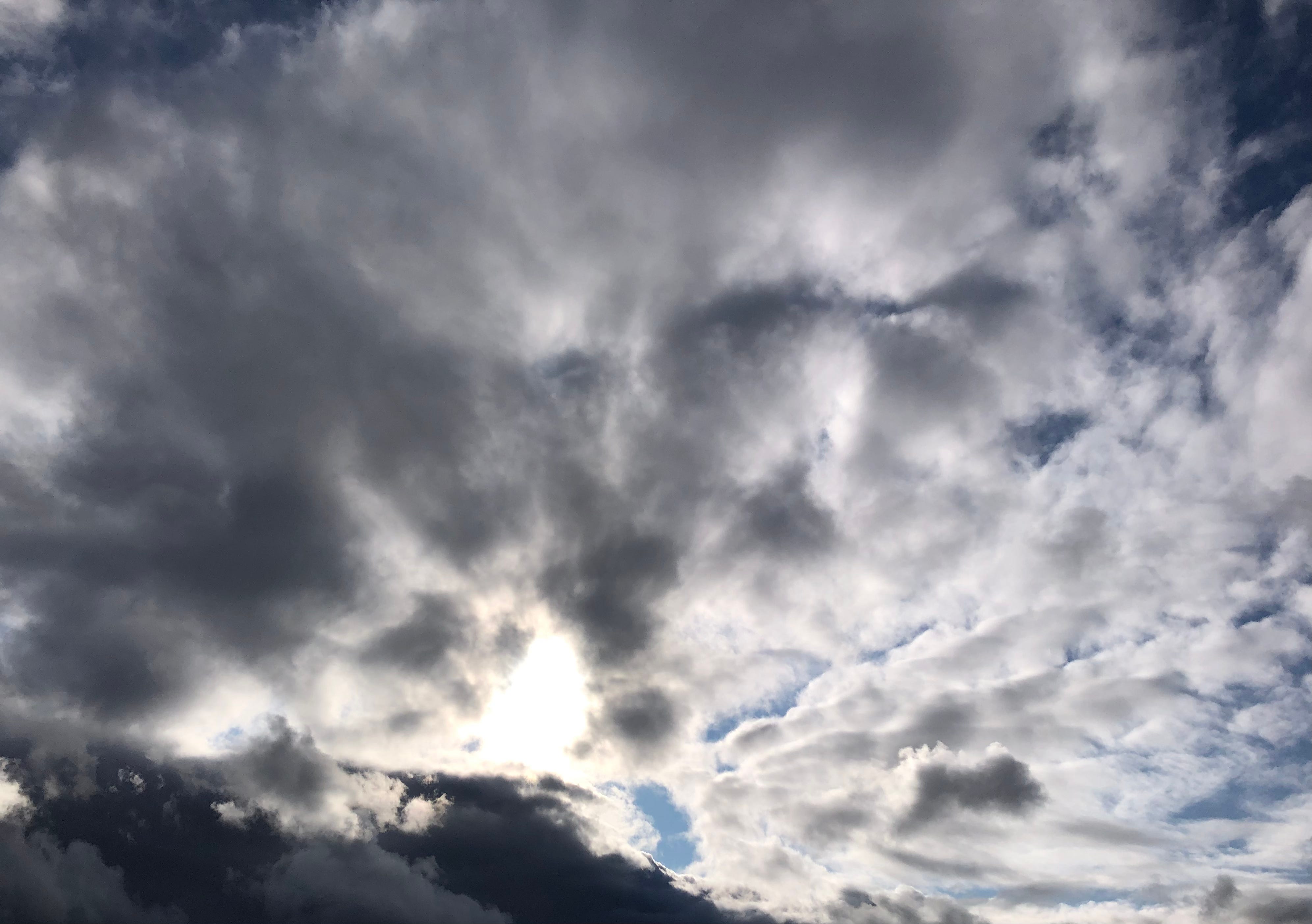
The living room is far less messy than usual - it had been tidied, and the floor has now been vacuumed. The kitchen has been cleaned. The apartment will be clean during the time nobody will be there. Some packing has now been done.
‘Helioscope’ means ‘telescope’.
The dishwasher is running.
The smell of warm pine trees indicates pleasant summer weather here. Swedish exceptionalism extends even to exception from continental heatwaves; while friends and family elsewhere are burning there are complaints here that it’s not warm enough; that ‘we’re not having a proper summer’.
On this little island there are houses, blades of grass, trees, slices of toast, jetties, magazines from the 1980s, and a Nintendo GameCube.
There are no thoughts. There are clouds.
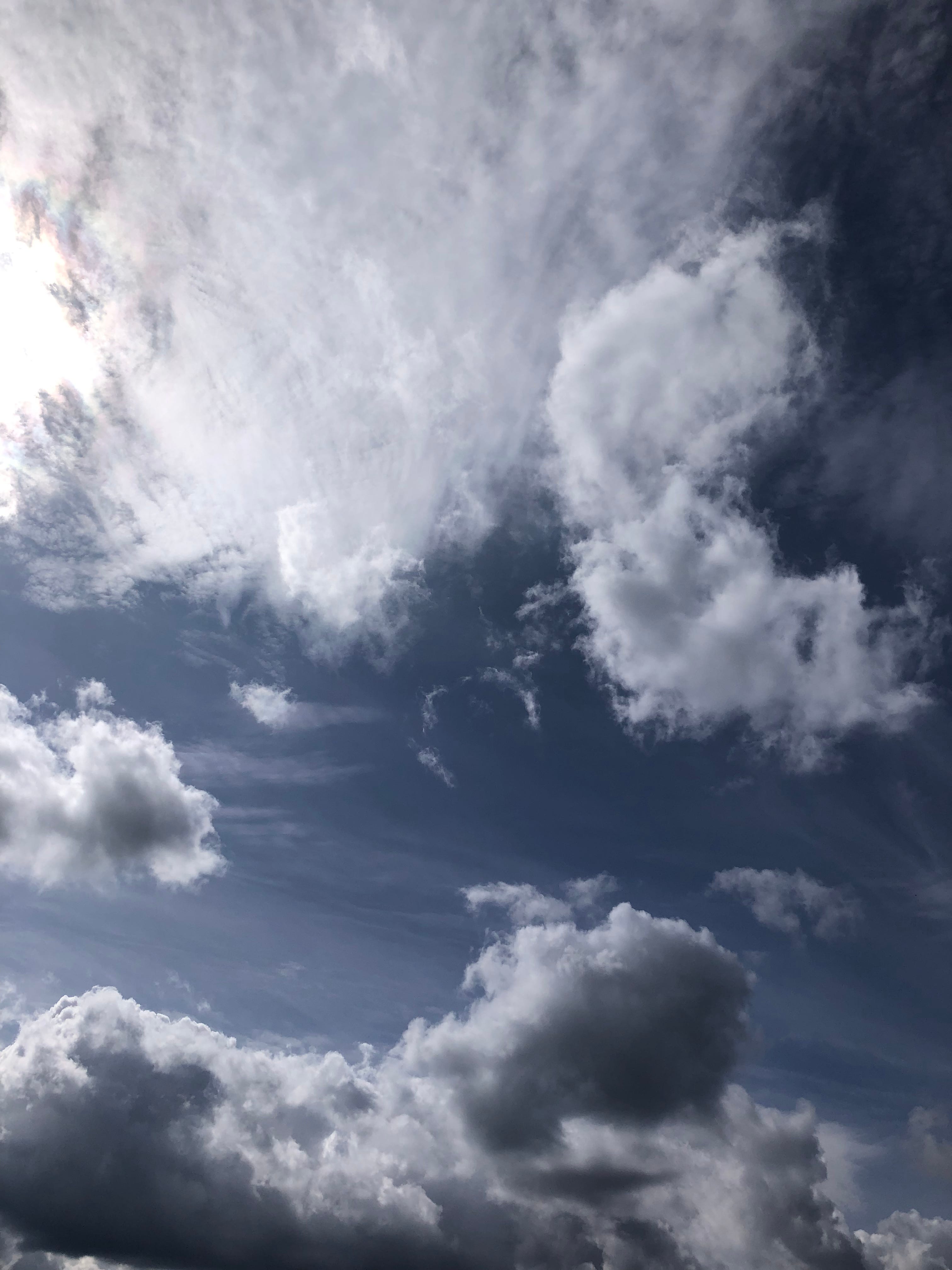
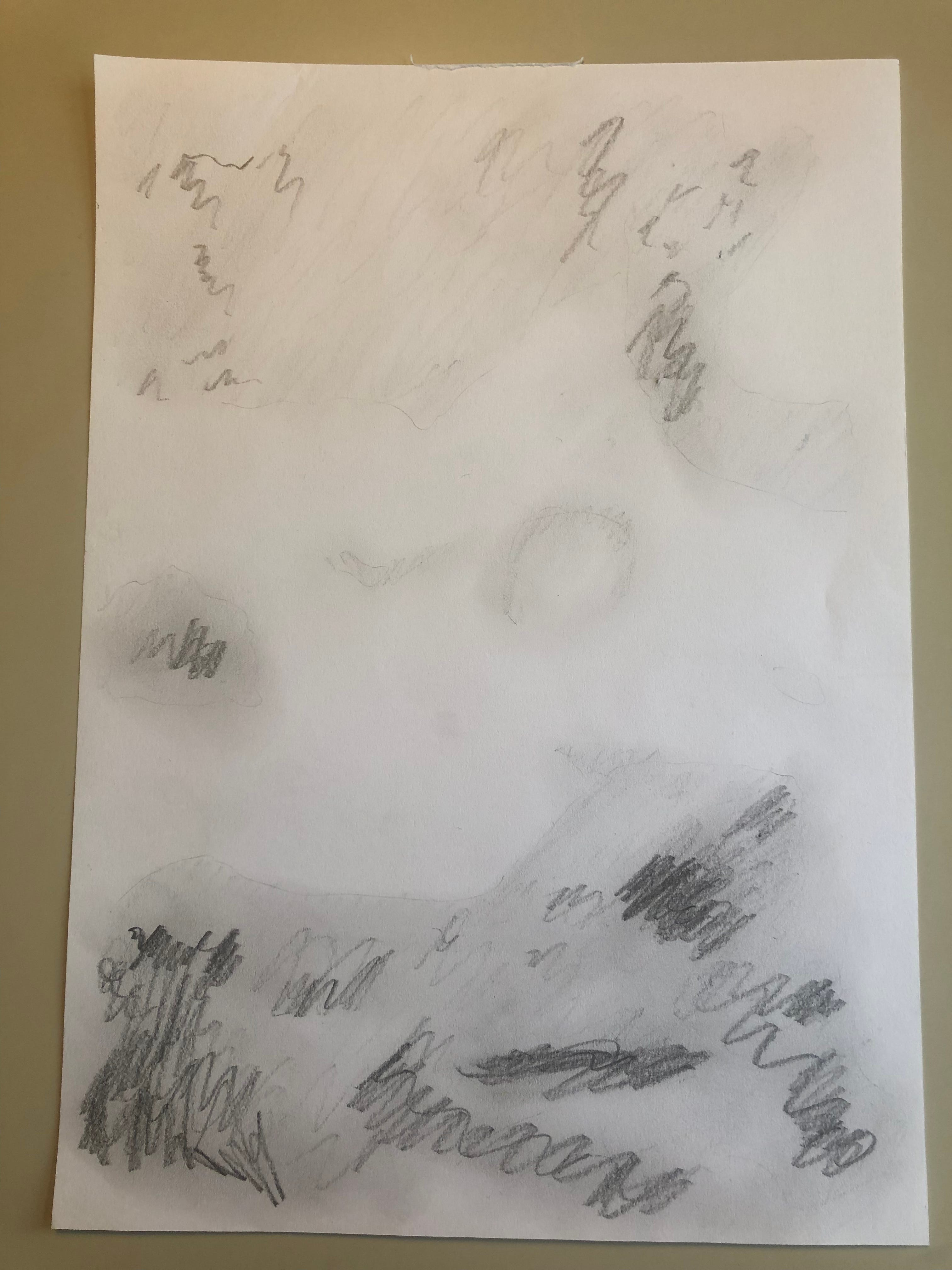
There are drawings of the same clouds.
There are clouds in an old pop-up book.
There are phones, and iPads showing films. There is a television. There are watercolour pencils. There are varying temperatures: sunlight, shade, water.
There is nothing to write about, not without the self. I can’t do it. I have nothing to write. I don’t even like writing; I’ve successfully estranged myself from it.
There is an injured blackbird, its feathers disheveled by the violence of a cat. There are snakes, beetles, mosquitoes and woodpeckers. There are a few deer, left stranded here after crossing the ice one winter. If the next winter is cold enough they’ll have a way back to another island.
A few months ago I applied for a part-time course in ‘art writing’, the exact field I’ve supposedly been working in for years. I will soon find out if I got a place on the course or not. The money one receives as a student in Sweden would help a lot with my financial predicament, and I also have quite a high capacity for writing about, and as, art. I would be an ideal candidate for the course.
It feels great to be using the word ‘I’ again. Only joking, it doesn’t feel any different. I was writing about myself the whole time anyway. But there are details of the ordinary that interest me in their own right, and they make me feel affectionate towards everything because I can read it all so clearly… oh wait, sorry, those are Fernando Pessoa’s thoughts, not mine.
Instead of writing I respond to long series of text messages by the French writer and the Belgian writer. They are thinking, and writing, all the time. They are also reading real books, not just pop-up books; they read real books which get to the source of various concerns and problems. Actually, I have also been reading science fiction novels, which imagine the end points of grand, cosmic concerns and problems but ignore any kind of emotional source. At the age of three and a half, my younger son has established his first dictum of literary criticism: pop-up books are better than non-pop-up books. It’s difficult to argue with this: how could a non-pop-up book be better than a pop-up book? What book wouldn’t be improved by being a pop-up book?
My only role is as the default provider of childcare, the childcarer of last resort, like the national or state bank of a country with a struggling economy, attempting to balance things through emotional quantitative easing; printing care. Others with legitimate activities do the things they must do, like going to work or tending to their gardens. The sun burns my skin, even though it’s not even a heatwave, and everyone gets annoyed with me. My younger son wants me to stop using my phone. He asks me to build an intricate sandcastle, which I do, and before leaving the beach he destroys it so that nobody else can enjoy it.
While walking on the gravel road that loops around the island we encounter a shirtless older man carrying a bluetooth speaker playing the song ‘Fernando’ by Abba. He seemed very happy.
I didn’t get into the art writing course. It’s quite disappointing, but also unsurprising. There is a relatively common phenomenon in Stockholm of artists arriving from other countries, or even other regions of Sweden, and expecting that they might continue their teaching careers in one of the city’s two art schools. After a number of failed job applications (in my case, without even getting as far as being interviewed), they realise they might need to study again first, as a kind of localisation exercise. After failing to get a place on a PhD program or other advanced postgraduate course they lower their expectations and apply to Masters degree courses. After failing to get into one of those, some joke darkly that they wouldn’t even get into a Bachelor’s degree course here, and they give up. They take their chances with ‘just being artists’, and settle for careers of exhibitions in second-rate and uncool galleries. I am the first person I know who has failed to even get into a relatively informal part-time ‘vocational’ course. Ironically, my bitter discontent at this rejection may manifest itself in something approximating ‘art writing’.
We are on a train heading towards the south of Sweden. My younger son is jumping around and shouting. His older brother is managing an online football team. A nearby young man is watching the film The Silence of the Lambs on a laptop. Another man was reading Utopia by Thomas More, but he has fallen asleep. A very tall Indian man is playing with a Rubik’s Cube, while watching a video showing methods of solving Rubik’s Cubes. My younger son now has a pair of headphones, so he can watch films rather than making life intolerable for everyone else in the carriage. He stops jumping around and shouting when he puts the headphones on. An unusual number of our fellow passengers have brought with them various kinds of pillows for the journey. One woman is sleeping with her mouth wide open, like a huge fish basking for smaller fish.
We are in a small fishing village where everything is beautiful - the light, the flowers, the houses, the sea, the beach, the woods and the food. My shortcomings as a parent and husband are made clear to me almost constantly. Even during moments when I think I’m doing okay I realise later that others have been noticing my failings. The problem is that my consciousness is battered and exhausted, and I must be failing to notice all that is going on around me. I’m not aware, in the moment, of how I’m letting people down.
After months of having no editing work at all, and it being a significant professional and personal problem (as well as an enormous mental relief; having no one else’s texts to make sense of), a job arrived exactly at the moment our holiday began. The text is hard to make sense of, and taking any time to work on it means compounding the ways in which I am ruining my family’s holiday by my very existence. Even if I work on it late at night when everyone else is sleeping I make things worse: the sound of my fingers typing on the computer is too loud in the small bedroom we are all sleeping in, and any extra tiredness I accumulate by staying up late means that the next day I am even worse company, and even less useful.
Every day I take photographs of clouds in the sky, and make drawings of the clouds, and send them to the Belgian writer. He does the same, sending his images to me.
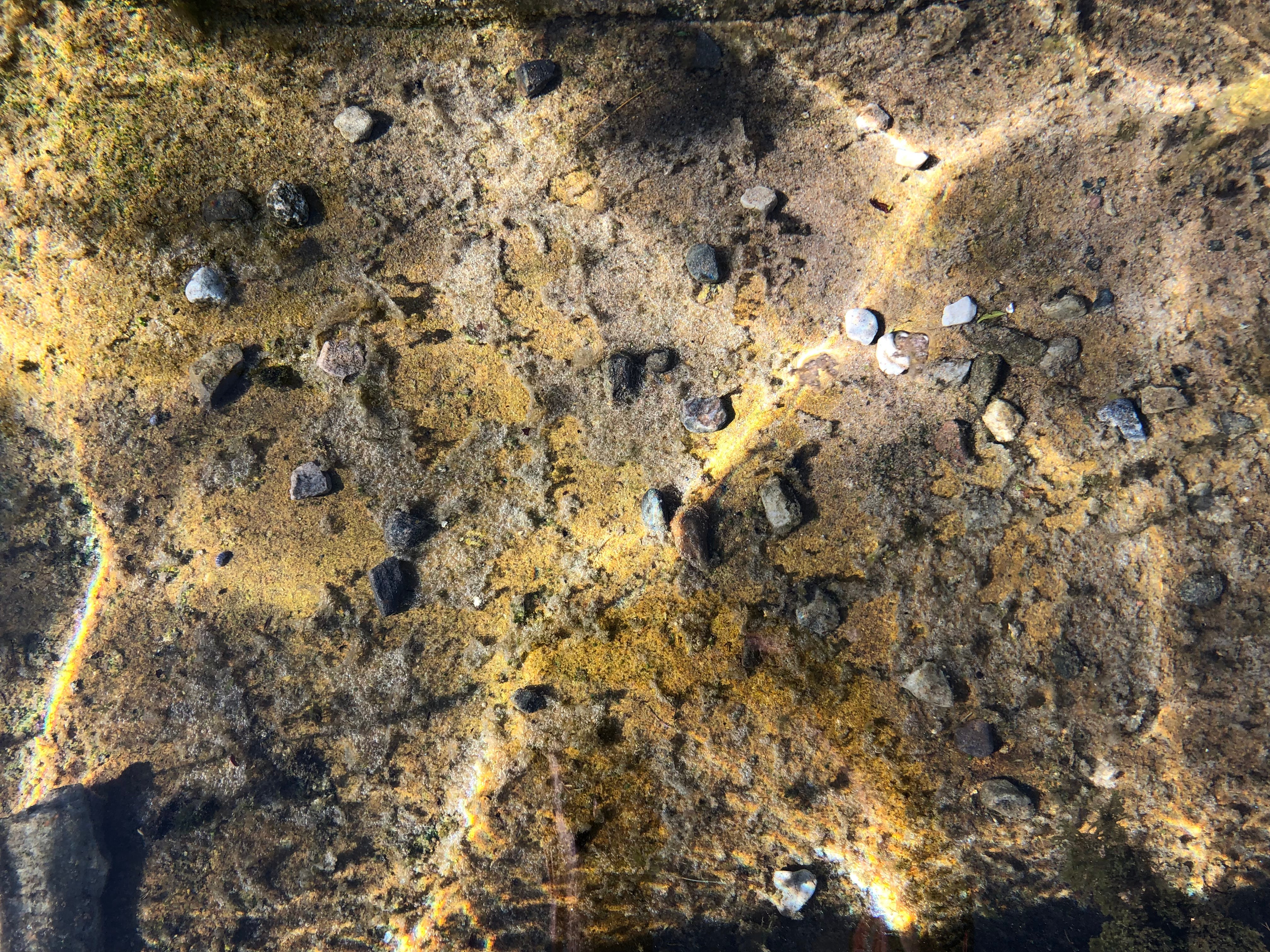
On the other side of the village there is a spring, the pure water from which runs into a stone tank before flowing out into the sea. It’s almost possible to regulate and normalise one’s existence by touching the cold water and closing one’s eyes.
But I’m too tired to regulate the basic systems of my body for long: its temperature, heart rate, thought rate, sweat, saliva, stride, breathing. I crash into things and trip over. When I go running I sweat so much the strap for my heart rate monitor slips out of position, and I stumble into rocks and brambles while trying to reposition it. This produces chaotic heart rate data for the run, making later analysis impossible. I misunderstand basic discourse, getting polite or intimate conversations wrong, and only realise much later on when I’ve said something strange or displeasing.
Yesterday my older son insisted on playing badminton in the garden, and I hit the shuttlecock directly into his eye. It was terrible, and for the rest of the night there was the real fear that permanent damage had been done. He screamed and howled, both in pain and in shocked incomprehension: how had I, his father, done something so unimaginably horrible? The pupil of the eye that I struck remained dilated even when his other eye adjusted itself to lower light levels. I felt in an instant that all the parenting I had done up until that point counted for nothing at all. All the care I’d taken over the course of nearly a decade was erased. There was no way of rationalising the situation so that it ‘wasn’t my fault’ - it was my fault. It’s difficult sometimes to administer my responses to all the different errors I make. They compound each other farcically, mistakes and errors and bad decisions with short-, medium- and long-term consequences all intersecting.
Everything has become totally meaningless. Ludicrous beautiful clouds against tonally complex blue skies. Incurring sunburn while being shouted at. Meeting up with extremely successful friends while depressed and exhausted, and hearing about their achievements. Starting from scratch each decade, year, month, week and day. Running the same paths and trails each decade, year, month, week and day. Reading the same books and publications each decade, year, month, week and day. Learning almost nothing, acquiring even less, and profiting from nothing. Losing, in fact; overseeing a diminishment of opportunities and prospects.
Why do men, everywhere, seem to be interested in a racquet sport called ‘Padel’? How and why did Padel start, and will its popularity signal the death of both tennis and squash? What is it about Padel that causes men not previously interested in racquet sports to become devotees of this one?
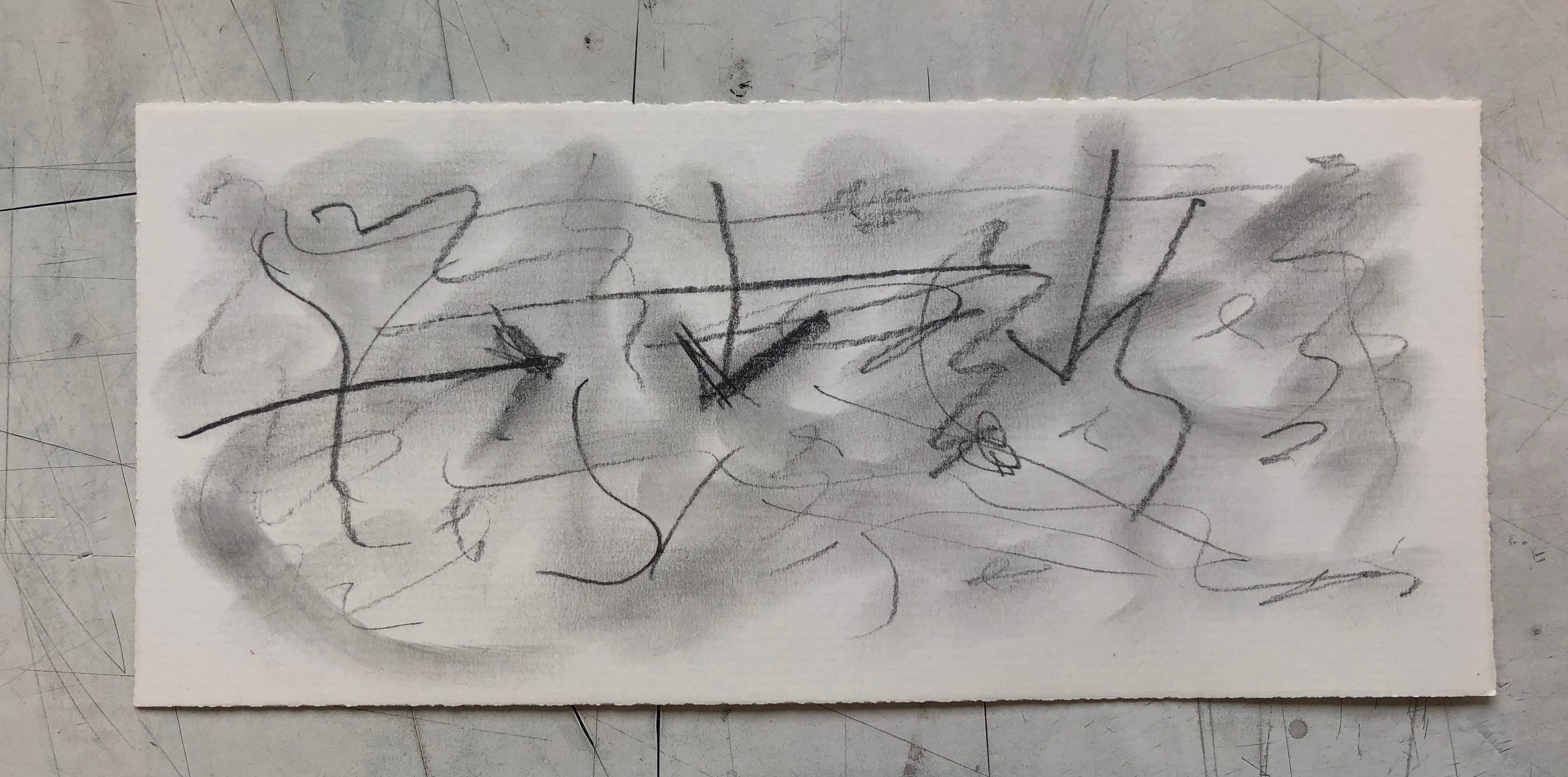
As well as drawing clouds I keep drawing ‘spaces’, generic spaces. Public ‘spaces’, private ‘spaces’, ‘art spaces’, ‘political spaces’, ‘empty spaces’. I also photograph these, and send both the photographs and the original drawings to the Belgian writer.
I have not been noticing details, however, or the actual phenomena of the world; its real spaces. Holidays are always a personal disaster for me; my mind and body collapse.
Meanwhile, various genocides continue. Although it is not the only one going on, the genocide in Gaza is the most public, modern and shamelessly conducted genocide most people can remember. Perhaps the Israeli state is trying to ‘complete’ the genocide in the manner of the most diligent video game players, seeking to attain statistical records and finish side-quests inessential to the main story: setting the record for how quickly a population can be starved, trying to kill journalists as quickly as they can report on the genocide, or before they even file their reports, seeing how many children can be killed or wounded in a short space of time; how many children’s limbs they can condemn to amputation. Because the perpetrators are treated with appeasement by nearly every other country, the cognitive dissonance amongst huge numbers of fairly normal, compassionate people in these other countries is causing mass distress and confusion, and the Israeli state and its supporters (who act like parents perpetually forgiving the monstrous acts of an amorally cruel teenage son) are managing to devalue human life itself, not just Palestinian life. It is unclear if this is also part of their objective - it may be that because they see no collateral damage when assaulting Palestine (anyone there is the enemy, and anything there is there to be flattened, eradicated and occupied) they are unaware of wider, global and psychological forms of collateral damage. Or perhaps they just don’t care. All that matters is the extinguishment of Palestinians. They keep murdering people queuing up for food, and murdering people being treated in hospitals, and then murdering the doctors and aid workers trying to help, and then murdering the journalists telling us about the murders.
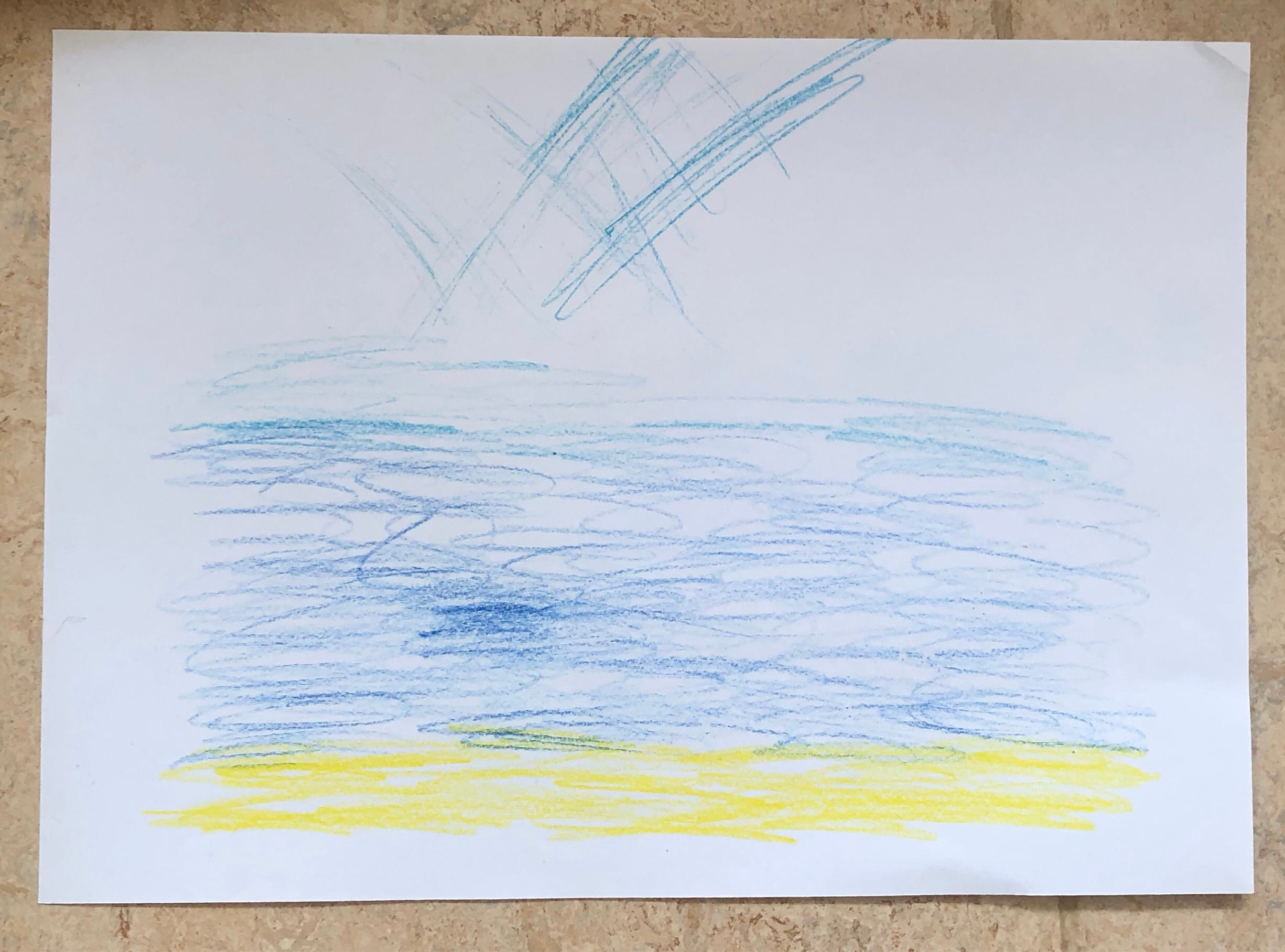
Nonetheless, people go on holiday to beaches. I drew a beach and the sea, and my younger son added ‘the rain’.
He says ‘fewmans’ instead of ‘humans’. If a group of people are cold he says that they are ‘frozened fewmans’. If I am visibly or audibly exhausted he says “your brain is so tired from all the days you’ve done today”.
When we get to Belgium I’ll meet the Belgian writer and see all the drawings I’ve sent, collected together, as well as the drawings of his that were made in response to them.
On this train there is no wifi network, so my older son’s iPad must be connected to my phone via a ‘mobile hotspot’. While searching for my ‘hotspot’ one can see a list of other nearby hotspots. Most people’s hotspots have names like ‘Jennifer’s iPhone’, or ‘Joakim’s hotspot’, or ‘Sara’s hotspot’, but one person has named their hotspot ‘Ragebait 2000’.
My younger son calls ‘grappling hooks’ (which are an important technology in the minds of children) ‘gravelling hooks’.
We spent nearly a week in Paris, where everything is ghostly (or I am ghostly, walking streets I know so well but which have changed, gentrified and been cleaned up). In its suburbs everything is exactly the same though; I went running and remembered individual paving stones, fig trees, insane pieces of 1980s architecture, post offices and football pitches.
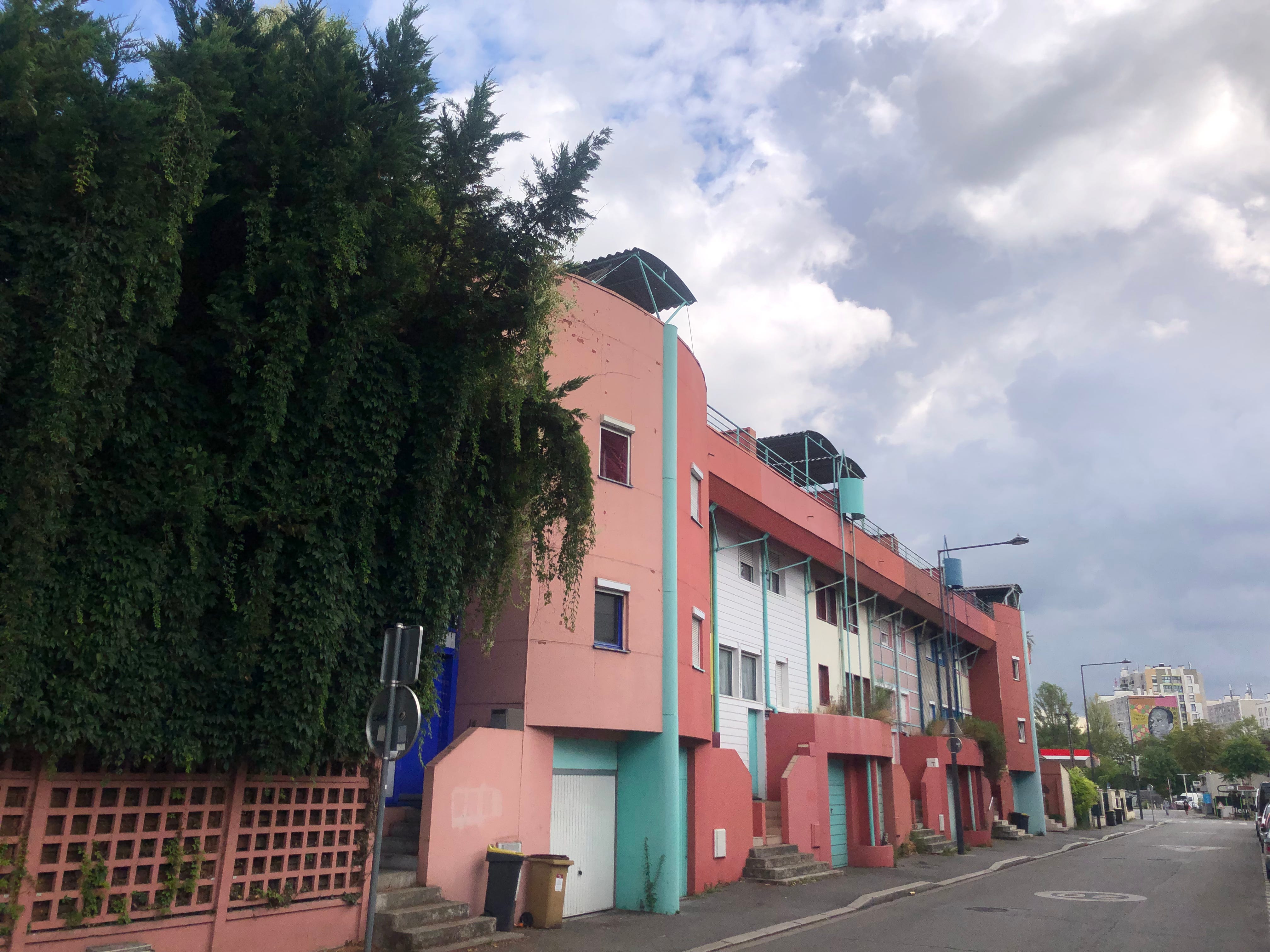
In the distance, a mural of Frantz Fanon. What bluffs would he be calling if he was around now? Would he use Twitter, and if so, would he have left Twitter when it became X?
We then spent nearly a week and a half at my parents’ house. I barely had the time to talk to my parents, and there was a farcical situation when I couldn’t find one of the cycling shoes I leave there so that I can go for bike rides without having to pack and travel with lots of kit. The more stressed I got looking for the cycling shoe the more I needed a bike ride to calm my brain down. I took my older son to a ‘water park’; a local leisure centre which has a few water slides. I hadn’t been there for approximately thirty years. It was his first time going on ‘big’ water slides. He went down the fastest slide before me, and I could hear his screams reverberating up the tube the whole way, from top to bottom. I then got in myself, and from the second I began descending I felt an overwhelming sensation of pleasure and peace. I’d forgotten that my favourite thing to do in all the world is going down water slides.
During the holiday I began reading (the?) two major series of unusual, experimental time travel-themed books: the ‘Time Rangers’ novels by Rob Childs, and the ‘On The Calculation of Volume’ series by Solveig Balle. In Balle’s novels a middle-aged woman, the narrator, begins to experience the same day over and over again. She lives in a small village in rural France, but on the repeating day has travelled to Paris to do some business (she is a rare book dealer). Solveig Balle is Danish, and like all such Scandinavian series of easy to read yet literary books, they have become extremely popular - ‘a phenomenon’. All respectable readers in Denmark, and now Sweden and Norway with France, America and Britain rapidly catching up, have been voraciously and excitedly reading the series. The books also have the great virtue of being set in the kind of French village their readers might wish to buy a house in, increasing their aspirational appeal, as well as allowing popularity in France itself and a possible film adaption presumably starring Sidse Babett Knudsen, maybe with Laurent Lucas playing her husband. Really oddly, the first book in the series does not acknowledge the existence of the film Groundhog Day at any point. Perhaps the non-acknowledgement of Groundhog Day is, discreetly, the deepest paradoxical mystery at the heart of the series. The ‘Time Rangers’ books by Rob Childs were published in the mid- to late-1990s and recount the adventures of a youth football team, Tanfield Rangers, who keep find themselves travelling through time. In the first book, A Shot in the Dark, it is the Easter holidays and they are on a team trip somewhere in the north of England, perhaps the Lake District. While wandering around near their campsite they encounter some mysterious and spooky ruins, where there is an archway through which they are transported to the same place but during medieval times - right into the middle of a chaotic proto-football match! In the other books of the series they are transported to Ancient Rome, the Second World War, a Victorian cotton mill in the north of England, a Viking seascape, central England during the mid-1500s (they encounter a young boy called ‘Will’ who is good at football but dreams of becoming a famous playwright…), and even the distant future, where football is played in a high-tech dome! The Tanfield Rangers players, and especially their right-back Worm (his nickname is derived from his being a ‘bookworm’) invariably solve a local problem in the place and time they are transported to before they can return to the present - and their next match. Unlike the narrator of the Solveig Balle books, the Tanfield Rangers players are largely unaffected by the existential implications of a collapse in the temporal order, and just get on with it. Furthermore, the Time Rangers books have pictures of the main characters. This is a useful addition.
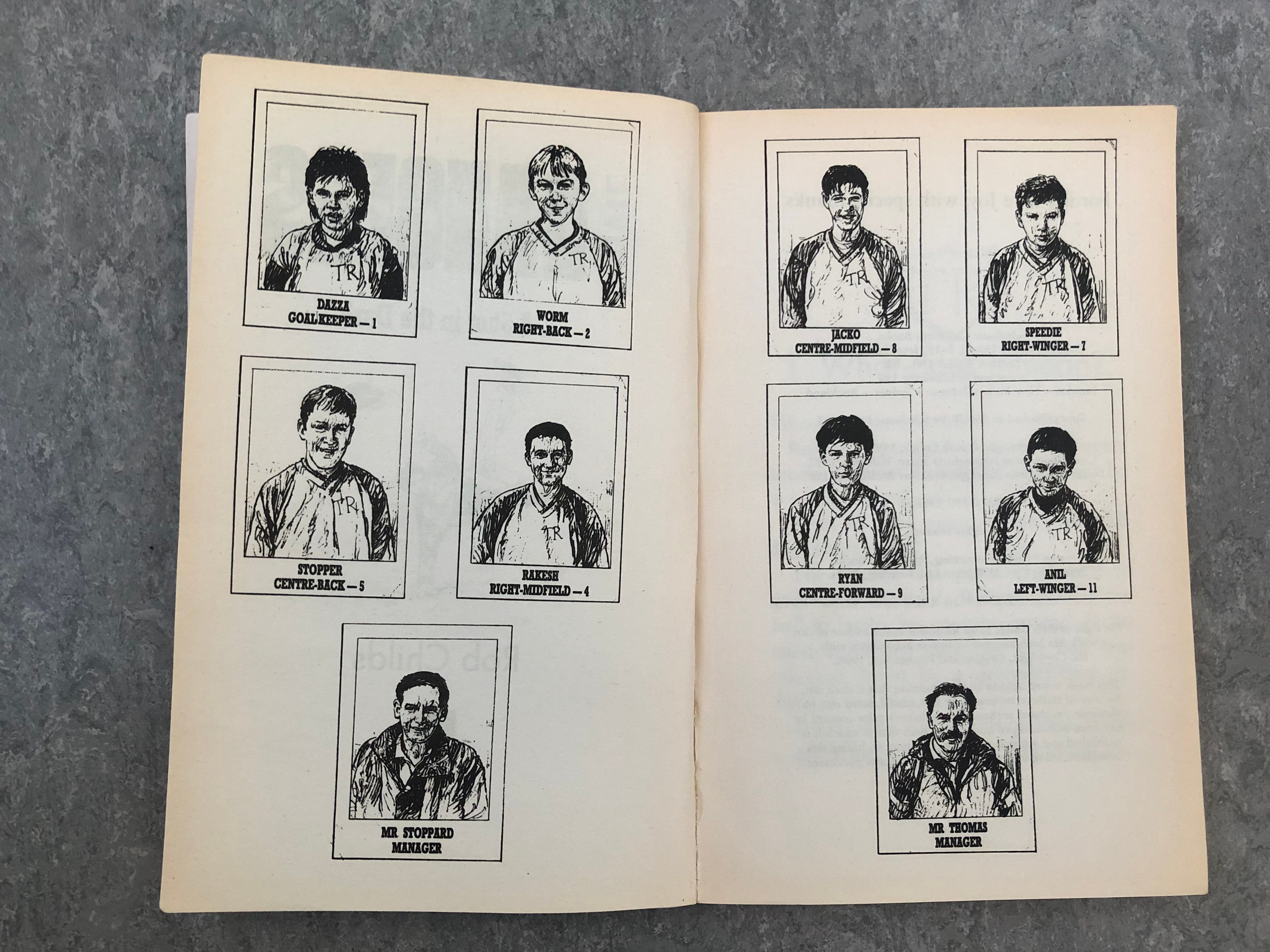
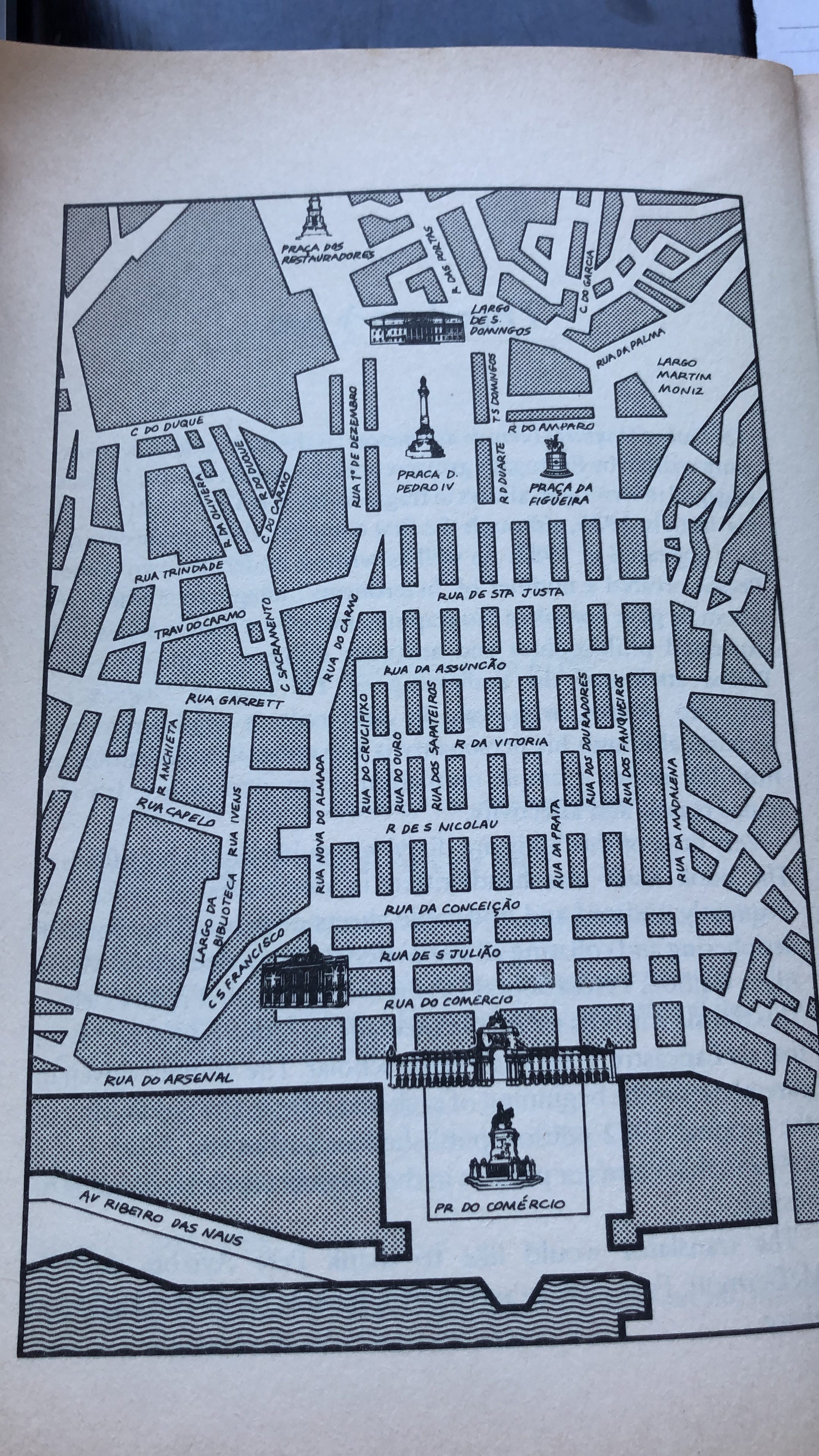
Perhaps it doesn’t add as much to a book at having pop-up sections, but it definitely improves on books that lack pictures of the characters at the beginning. I asked my son to explain more about what makes pop-up books better than non-pop-up books and he explained that, unlike other books, pop-up books ‘do something’. The fact that literature doesn’t do anything is arguably a wider problem than just its lack of pop-ups, but his point remains a good one. Some English translations of The Book of Disquiet at least have a map of Pessoa’s Lisbon at the beginning, but unfortunately don’t have pictures of Bernardo Soares, Mr. Vasques, Moreira the bookkeeper, the barber, the waiter, the post-boy or any of the others.
My father was sorrowfully remembering an old friend, a work colleague, from the West Bank. They spent much of 1969 together in Oman, and my father’s friend was looking forward to some aspects of daily life getting back to ‘normal’ in the aftermath of the 1967 war - he didn’t really believe that Israel’s incursions into the West Bank would last. In my father’s study there is a cabinet with a huge number of maps, collected and used over the course of many decades. He has been laying them out and tracing the violent swelling of Israel’s borders and remembering all the places he has been to in its neighbouring countries, all the completely normal lives and families, hobbies, interests, marriages, births and deaths there, all swept into history.
We returned to Sweden via Belgium, where almost all my friends are (for some reason). For two to three days most years we visit there and I temporarily have a small group of friends, together in one place. My writer friend and I had grand plans to make a quick exhibition of the drawings we’ve been sending each other, plans which were then scaled back to a more modest idea of making a quick publication using the drawings, which were then simplified to just photocopying all the drawings, and which finally ended up with us surreptitiously spending ten minutes together leafing through them. There were far too many drawings to look at.
My French writer friend, who by this point is almost the only person reading these stupid iPhone notes, has had a serious cycling accident. He is stuck in the neurology ward of a large German hospital where he is obliged to remain lying down for an indefinite period of time while teams of doctors observe, scan and analyse his head. Among other things, there is a mysterious leakage of ‘cranial fluid’ at the back of his head, or perhaps at the top of his spine, which causes him to have intense headaches if he stands up for any more than ten or fifteen minutes. Immobile and confined, he has begun writing iPhone notes:
“During the evening I made the acquaintance of an extremely friendly hospital porter. While rolling my bed towards the Very Large Scanner he told me that every summer he goes on a road trip to Scotland, that the Scottish are, beyond any doubt, the friendliest people in the world, and that the scenery there is entrancing. I had no difficulty believing him, having previously seen a photograph of Scotland’s splendid landscapes, and never having encountered an unpleasant Scottish person.”
I heard about his accident while travelling back to Sweden on a night train. The journey was so packed with incident that its resultant anecdotes would usually generate a whole iPhone note of hilarious stories and bleak reflections on my self and my purpose and usefulness in the world. That iPhone notes does not exist.
If I had been writing iPhones notes during my early childhood I would have described many night train journeys between Glasgow and London, as well as aeroplane journeys between the same cities when I was allowed to visit the cabin and speak to the pilots as they flew the plane.
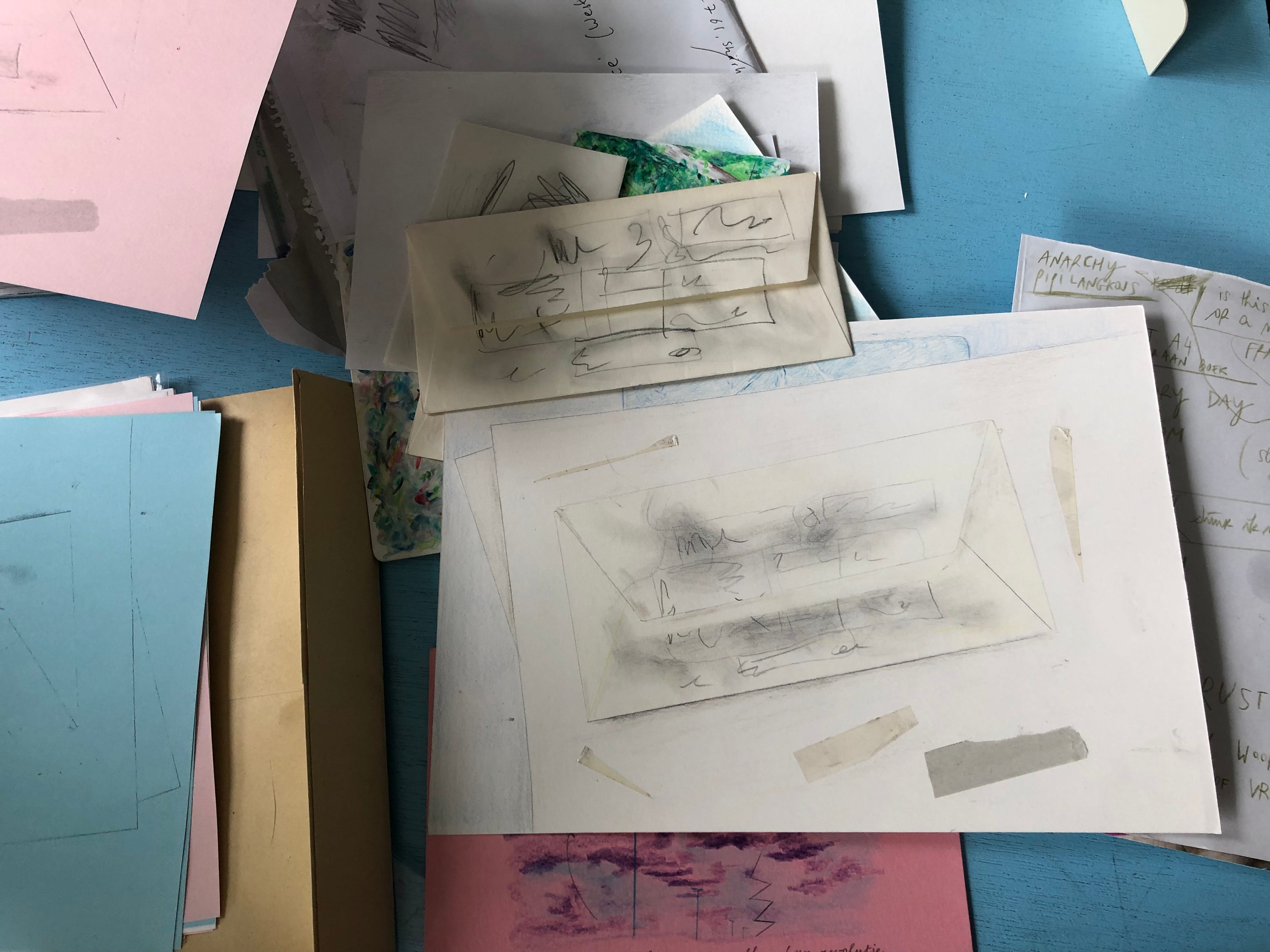
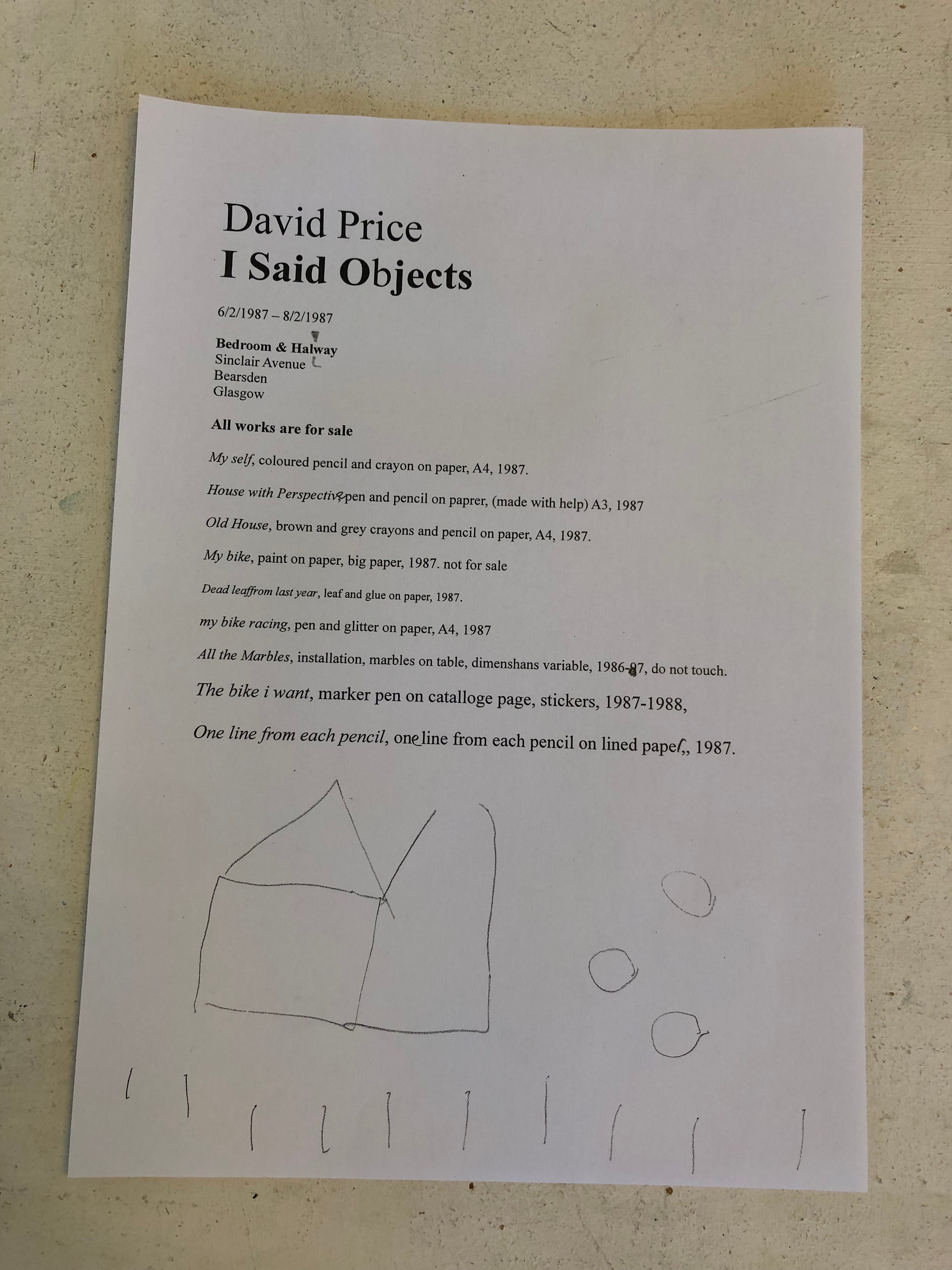
I’ve been making more and more leaflets for exhibitions that will not exist, leaflets for fictional exhibitions ‘set’ long into the future, at fictional galleries and with fictional works and fictional collaborators. I also made one leaflet for an exhibition that did not happen in the past, just before my fifth birthday.
Now that our holiday is over I am occupied with improvised forms of childcare that I’m too tired to perform. My exhaustion focusses itself on the middle of the day, the time when I should or could be active and doing ‘something’. I have no employment, and the final result of my application to the art writing course turned out to be that I was 69th on the waiting list. I think the course admits 12 students, so I can temper my profound sense of rejection a bit - I was the 82nd most appealing Swedish practitioner of English-language art writing to apply. I got into the top one hundred. I should feel proud. 💯 🔥
In the absence of any work, and so as to avoid having to find a menial job that would plunge me into humiliation and depression, my wife helped me to apply for a wide range of other, lower level university courses that would be either interesting or easy, or both - surveys of literary imaginaries and contemporary theory, all conducted in English. ‘Intercultural literary studies: academic writing’. ‘Intercultural literary studies: theory and method’. ‘World literature in English’. ‘American post-war literature’. ‘Shakespeare and contemporary culture in a global perspective’. ‘Conflict and creativity in English-language literature’. It was assumed that I’d get into at least one of them, but after a few days rejections, disqualifications and warnings began to arrive. ‘English literature in conflict’. I was ‘obehörig’ - ‘ineligible’ or, literally, ‘uncompetent’. Because of not having the original copies of my old BA and MA certificates all I had to upload into the central admissions system was evidence of my Ph.D, but it was worth nothing. It didn’t show that I was at the level of a Swedish school-leaver or BA graduate. ‘English: postcolonial text and theory’. I would have to give evidence of my ‘reell kompetens’; something that would show I had equivalent ‘prior learning’ to those emerging from the Swedish educational system. ‘Intercultural literary studies’. But all I had was my Ph.D. I telephoned the admissions offices of the various universities to explain my situation, but there was no hint of sympathy or flexibility. The more I tried to explain my Ph.D, about how it touched on many aspects of the short courses I was applying for, and about how writing such a dissertation (however boring and uninspiring it may be to read) surely showed I might be at a level where I could attempt a short course at Swedish BA level, the more ineligible I began to feel. Everything I said made me seem more suspicious and more in/uncompetent, and cast more doubt on my background and suitability for admission. I began to wonder myself if I had actually done any of the studies I was claiming. At the end of a long and embarrassing conversation with the admissions office of Sweden’s most prestigious university my English language abilities were called into question. Fair enough, perhaps. I began to look for courses at even lower levels, first year introductory modules, but it still didn’t work - there was no certified evidence that my English was at the level of a Swedish high-school graduate. ‘Working-Class Literature: Historical and International Perspectives’. It also became evident that my Swedish would be at too low a level to be able to sit the exams that could certify my aptitude in English. How far back into the school system would I have to go to re-emerge as a candidate for university studies? My son brought home the novel he and his classmates are reading and commenting on each week for their homework, and my wife said that the Swedish text was too advanced for me to be able to help him. A bad sign: he is ten years old. But if I started school again from the beginning, amongst Swedish 6 year-olds, I would be too big for the tables and chairs (even though I’m quite small), and the lunch portions would be insufficient for me. I’d get hungry during the afternoon, and maybe fall asleep or start being naughty. If that behaviour was punished with expulsion my incongruity might make it hard to find another school that would accept me. Parents might object: ‘not only is he a kind of adult, albeit a little man with a red beard,’ they’d say, ‘but he’s already been thrown out of one school - should he really be allowed into another?’
The French writer’s iPhone notes are sublime, and more than replace mine in the world (I am continuing to write this iPhone note exclusively for him, because he likes reading them and I have the vague hope that knowing I’m writing one might aid his recovery in some small way, yet I’m very conscious that I no longer need to write iPhone notes, both because someone else now is, and simply because I no longer have any aspirations to write). Even in these crude translations his iPhone notes are funny, and disarmingly matter-of-fact:
“My second encounter with the Very Large Scanner took place without any difficulties, except that this time, within the machine, I experienced time in a bizarrely cyclical manner. Once I had been inside for perhaps a quarter of an hour I felt very clearly that time was not following a linear sequence, from one time to another, but that the same short sequence of time was repeating, in a loop, and within this loop all the phenomena belonging to that short sequence were repeating too. I noticed again and again the short sequence of time and the phenomena and, because of how insidious and destructive it was that time seemed to be consuming itself, I almost pressed the little emergency button that had been placed in my hand. But as soon as I was removed from the machine my porter was there again, and he continued to tell me about the Scots and the warmth one finds amongst them, even if one is not Scottish oneself…”
Did I really move to London and go to art school, a process leading to my receiving a BA qualification? Did I really spend four years there, living all over the city, learning how to use all kinds of cameras (but not how to take photographs or make films), and slowly learning how to write as well? Did I really start looking at the same few Sol LeWitt books over and over again? Did I really write my final dissertation about Heidegger and the idea of ‘emptiness’? If so, why? Did some friends and I really move into a collapsing rented house at the beginning of our second year, on the day of 9/11, but fail to watch what was happening because we didn’t have a television? Did I really become more and more anxious as the West’s centuries of misadventures in the Middle East and beyond came back to bite it, severely? Did I really start going to the other art schools in London to visit friends and see if the libraries of these other schools had different Sol LeWitt books? Did I really start making silent, slow motion videos where the camera just glanced at something, a tree or some clouds, and bobbed around?
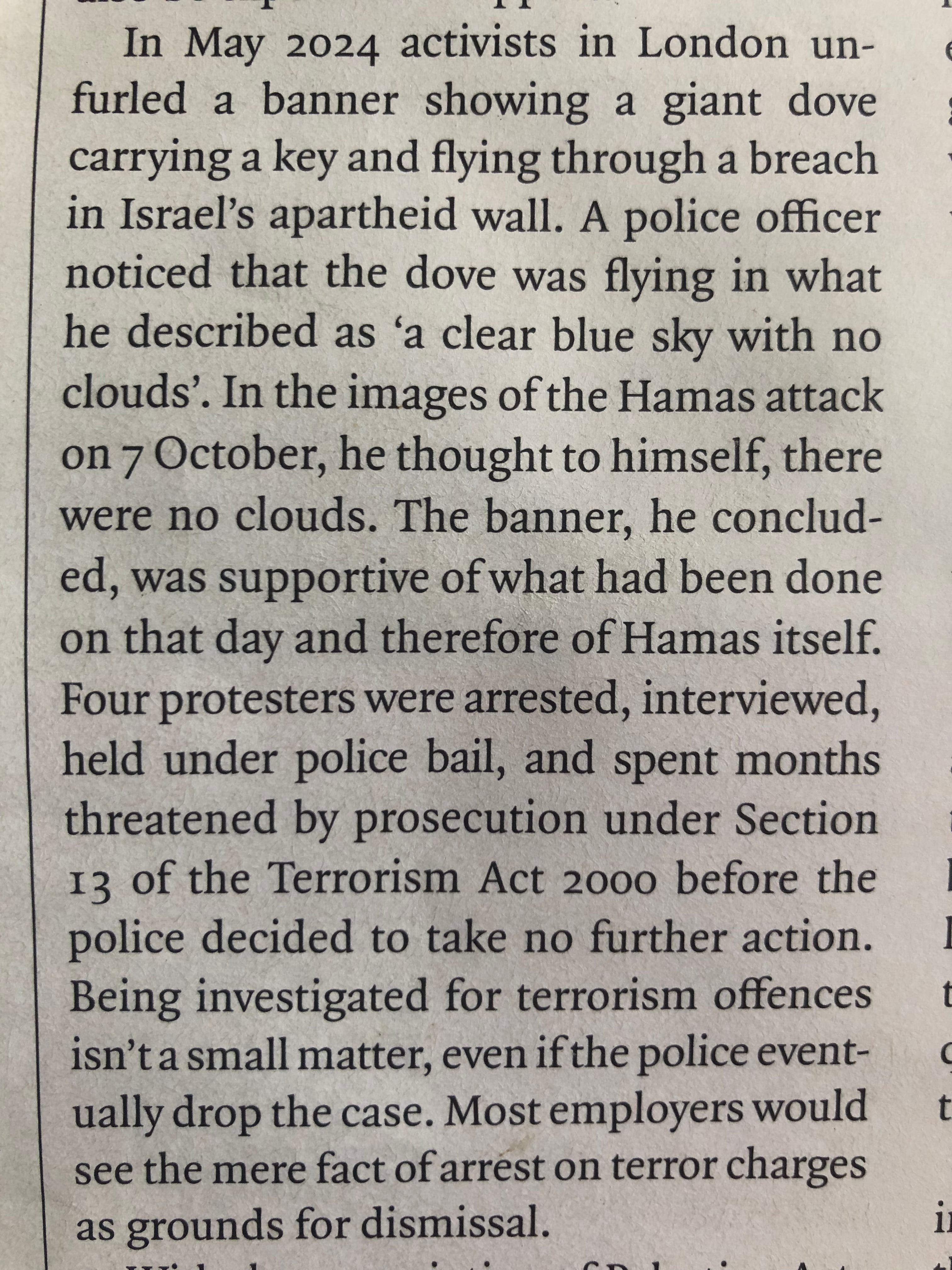
The Israeli state continues to slaughter, imprison, starve, herd and torture the people of Gaza. It, along with many of its civilians, also continue to kill and wound the people of the West Bank, and eject them from their homes. The British state continues to make itself as unappealing as possible to anyone with a conscience by punishing those who oppose Israel’s genocide.
During a week spent at home with my younger son, my brain constantly tired from all the days I did each day, I rewatched Closeup by Abbas Kiarostami in small instalments. If I really studied art in London just over twenty years ago then I probably first watched it there. Did I sometimes, often even, cycle all the way from Camberwell to Hammersmith, through multiple dystopias, to watch double-bills at the Riverside Studios? And then cycle back again? Did I really watch The Taste of Cherries on VHS on the little television in the old art school library and then watch it again shortly afterwards as part of such a double-bill? If so, what would I have understood of what I was watching, decades before I too became a sad but thoughtful man with a moustache, just like one of Kiarostami’s characters?
The French writer continues to send his iPhone notes, now describing the man he is sharing his hospital room with, and surprised at his use of the past tense to describe ongoing events:
“Olaf was a man who would always give himself something to do. There was never a moment during which Olaf wasn’t active somewhere in the room. And because he did everything in such a rigorous and ordered way, and so slowly, his little projects stretched out over a nearly limitless duration. It took him almost two hours to set out the small number of possessions he had brought with him in a little bag, and almost thirty minutes to take a photo at the window, and almost forty minutes to move his cup from the shelf to the table, and all of fifty-five minutes to throw an empty yoghurt pot in the rubbish bin. I could hear him all the time, slowly and gently carrying out these projects and other ones too…”
He doesn’t understand why he is using the past tense, in a way he himself dislikes, to describe the present. It doesn’t make sense to him. If only it were possible to place the photograph Olaf took at the window here. That’s what I would do. Abbas Kiorastami would be more ambitious; he would arrange for everyone involved to restage all the events described and make a film out of it: my writer friend would reenact his bicycle crash and subsequent unconsciousness, then his days of confusion and increasing awareness of severe concussion, then suspicion of more sinister symptoms, then his admission to hospital. The porter would reenact his affectionate discourses on Scotland and the Scots as his pushed my friend around the hospital, retracing their routes to and from the scanner. The doctors would restage their analyses of my friend, poring over images of his brain. Olaf would restage the painstaking rearrangement of his possessions, and then finally retake his photograph at the window of the hospital room. The film would suddenly cut to the still photograph, and the film’s final credits would begin.
The beginning of Closeup gives the impression that the film will be boring, and awkward even: rigorous cinema vérité at the cost of narrative sensuality. But then a small metal canister, maybe an aerosol can, rattles down a suburban hill and suddenly the viewer notices they’re watching cinematic thought at a higher level than almost anyone else has been capable of. Or inverted cinema, film replacing the reality it’s meant to be a film of. Within a few more minutes the film is both asking and answering the question ‘why make a film?’ The man at the centre of the film pretends to be a film-maker but isn’t one, has a deep appreciation and love of film, and explains himself rather than playing himself. A film is made of what happened when he let it be believed that he would make a film, but didn’t or couldn’t because he was not a film-maker. At the end he is rescued by the man he was pretending to be, who takes him to apologise to the people he deceived, but did not harm.
Did I really stand around filming puddles near Ladbroke Grove tube station on 16mm film, focussing on the reflections of clouds and of the plane trees that lined the pavement, engaging the ‘slow motion’ function of the college’s old Bolex camera, only to watch the film back once in the darkness of the art school’s lecture theatre then never again? Did I really go and watch Stalker in the smallest screening room of the ICA? Did I really read Tarkovsky’s diaries? Did I really start cycling to and from London and my parents’ house in the country? Did I really work in the Music and Video Exchange shops in Notting Hill to earn some extra money, acquiring the 12” single of ‘Penelope Tree’ by Felt using my staff discount?
PHOTO
Released from hospital, the French writer sends a video clip from a rainy cemetery, which is just like (in spirit) a fragment from a Kiarostami film. Rather than the car or awning Kiarostami would use as a shelter for the camera, he uses an umbrella.
He sends a small description, which I put into Google Translate to create its Kiarostami-voiceover form.
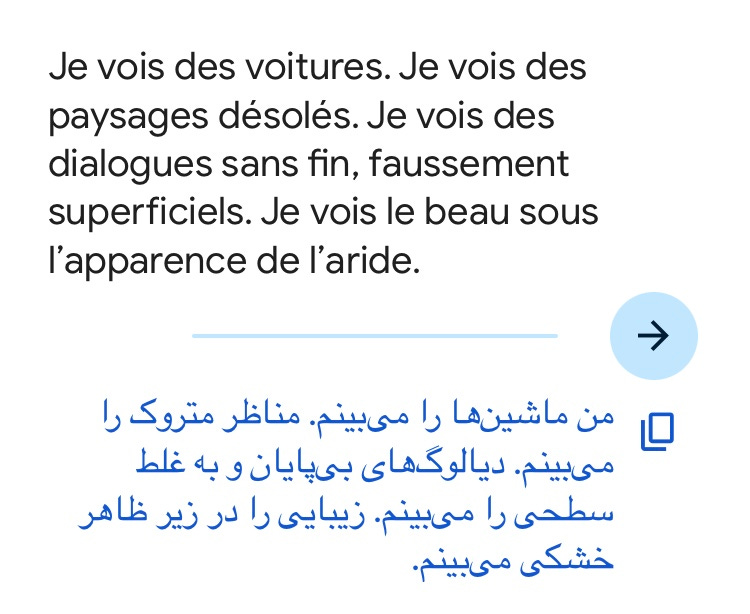
If either of us had the time I’d suggest that he finds an agreeable Persian speaker to record the voiceover, perhaps a young woman working as a school teacher, her voice full of cautious hope. It would be one of many such descriptions she’d make of her daily life, which she’d recount to an elderly Iranian man she makes friends with. They’d sit together on benches around the city, including in the cemetery itself, and she would tell him in the present tense about things she had seen in the recent past, elsewhere in the city. The descriptions would never correspond to where they actually were. Reviews of this film, for which my friend would win a Golden Lion award, would talk about the way it ‘articulates displacement’; the film would allow reviewers (urbane white men with nice clothes) to imagine they were able to understand the ‘doubled, echoed self of the immigrant’. The woman playing the young school teacher would become a star of independent cinema, and the elderly man, who had never previously acted, would be celebrated for the dignified, discreet charm of his performance, and he would be garishly patronised on red carpets across western Europe. Documentaries would be made for Arte about his past, his flight from the 1979 revolution, his time spent working as a labourer in a small German city, his rise in the trade union movement and his struggles to become a naturalised German citizen, before describing the work-related accident that caused him to take early retirement and settle into a quiet life, living alone in social housing, making excursions to sit on benches and talking to anyone who sat down next to him. My friend would begin a new film project, adding voiceovers to still images of old photographs found in flea markets, which would attract the attention of Tacita Dean, who would in turn introduce my friend to Joanna Hogg, who would help him fund film adaptions of his earlier novels, shot on beautifully sober 35mm film.
Did I really spend my years at art school shooting roll after roll of Super8 film? In the absence of any certification for my degrees, do I really have boxes of those films here in the apartment, but am too scared of their emulsified emotions to watch them? The Swedish central university admissions system does not recognise archives of nostalgic potential. The administrators of another short course I was rejected for, ‘Film experience: theories and applications’, said that I would have to go even further back and provide high-school transcripts to show I was ready to enter university at the level of a first-year student. Maybe the system is right, and I’m not ready.
The timeline is all messed up. I’ve gone into this iPhone note and added new parts at random. At some point after watching Closeup I watched what must surely be one of the best films ever made by anyone, not just Kiarostami, The Chorus. An elderly man is out in the city, performing an errand (he’s buying some radishes). On his way he encounters various simple phenomena of great complexity: a horse and cart, pigeons, a seller of copper pots, etc. The man is deaf, or almost deaf, and during his outing he regulates his interface with audible reality by taking the earpiece of his hearing aid device in and out. When he takes it out the viewer hears as little as he does. He returns home to his rooms and removes the earpiece more definitively, then prepares and tastes a radish and pours himself a cup of tea and settles down. Meanwhile, a large group of little girls who have just left school gradually assemble outside his window, shouting up to him and eventually throwing stones at the window to get his attention. He cannot hear them. After a while he checks the time, puts his earpiece back in, and goes to the window. He opens it to see the teeming mass of delightedly shouting little girls, and he smiles.
A curious feeling of drift and fragmentation. My ‘life’ is composed like a torrent file; it is a series of small instructions about where and when parts of a whole might fit together. All the parts themselves are located in an infinity of different places and times: the school, the kindergarten, the football pitch, the studio, the living room, the kitchen, the basement, the supermarket, the small pieces of wasteland near the studio where weeds and grasses grow against concrete and in rubble.
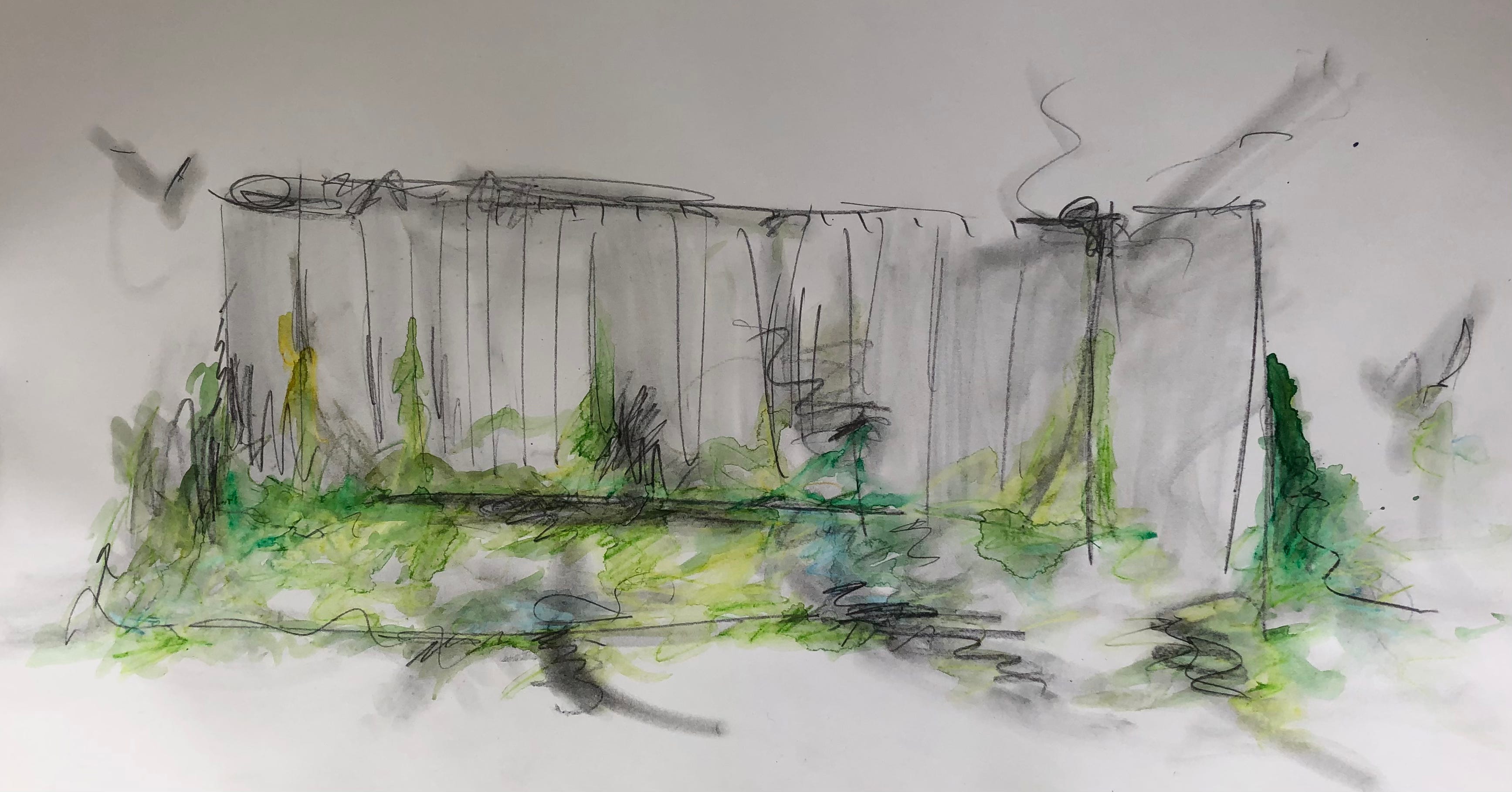
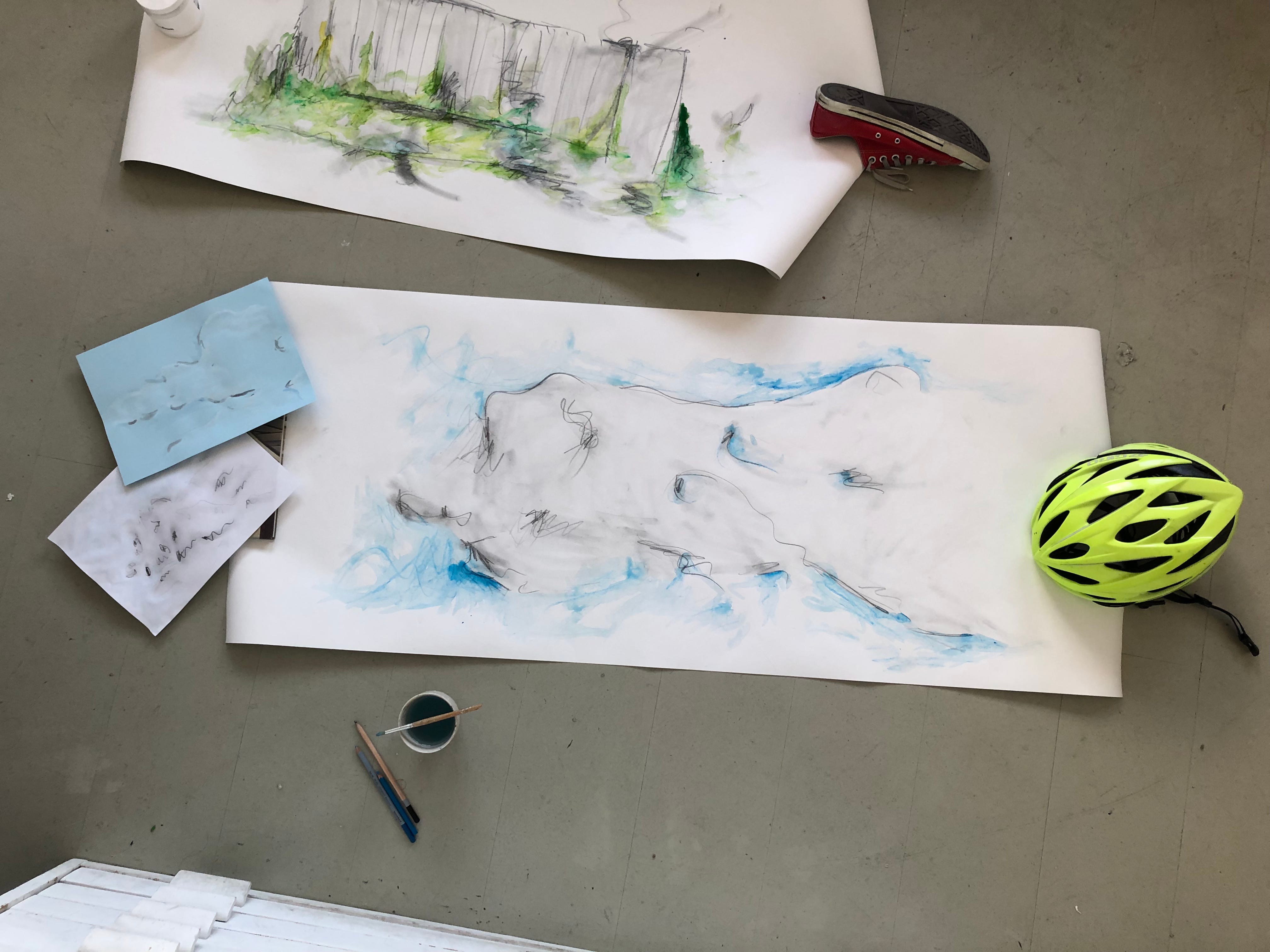
I’ve been drawing some of these areas of growth on huge lengths of white wallpaper. The drawings are exactly the same as sketches made on smaller sheets of paper, but bigger.
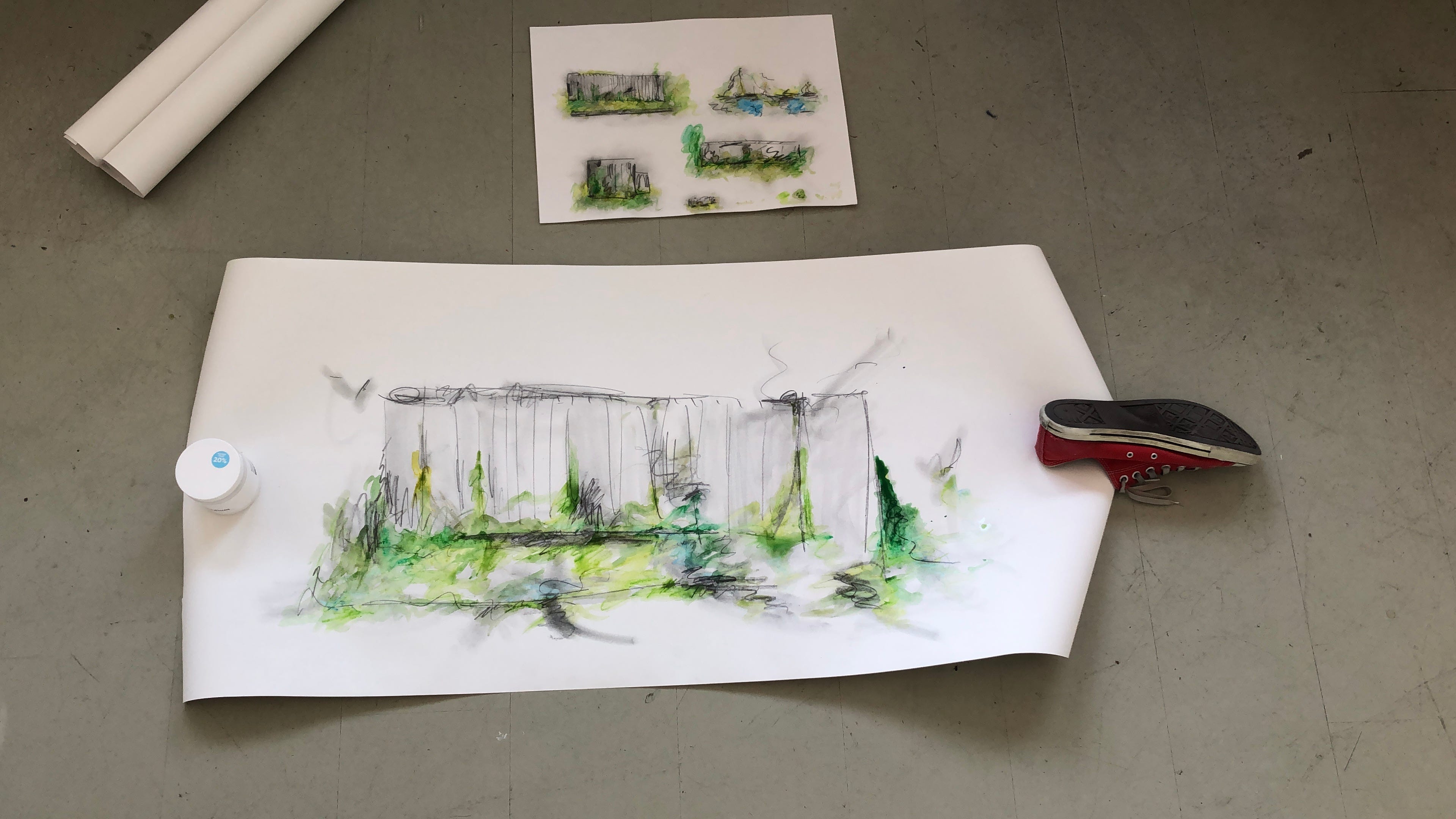
To be honest, these drawings are a little too conventional for my liking. Too much like specific spaces and not enough like notions of generic space. They might even be useful as ‘illustrations’. Imagine being an illustrator! But perhaps by being big, the larger drawings will achieve some kind of legitimacy? Perhaps I will achieve some kind of legitimacy through them? I’ve been doing the same thing with pictures of certain clouds.
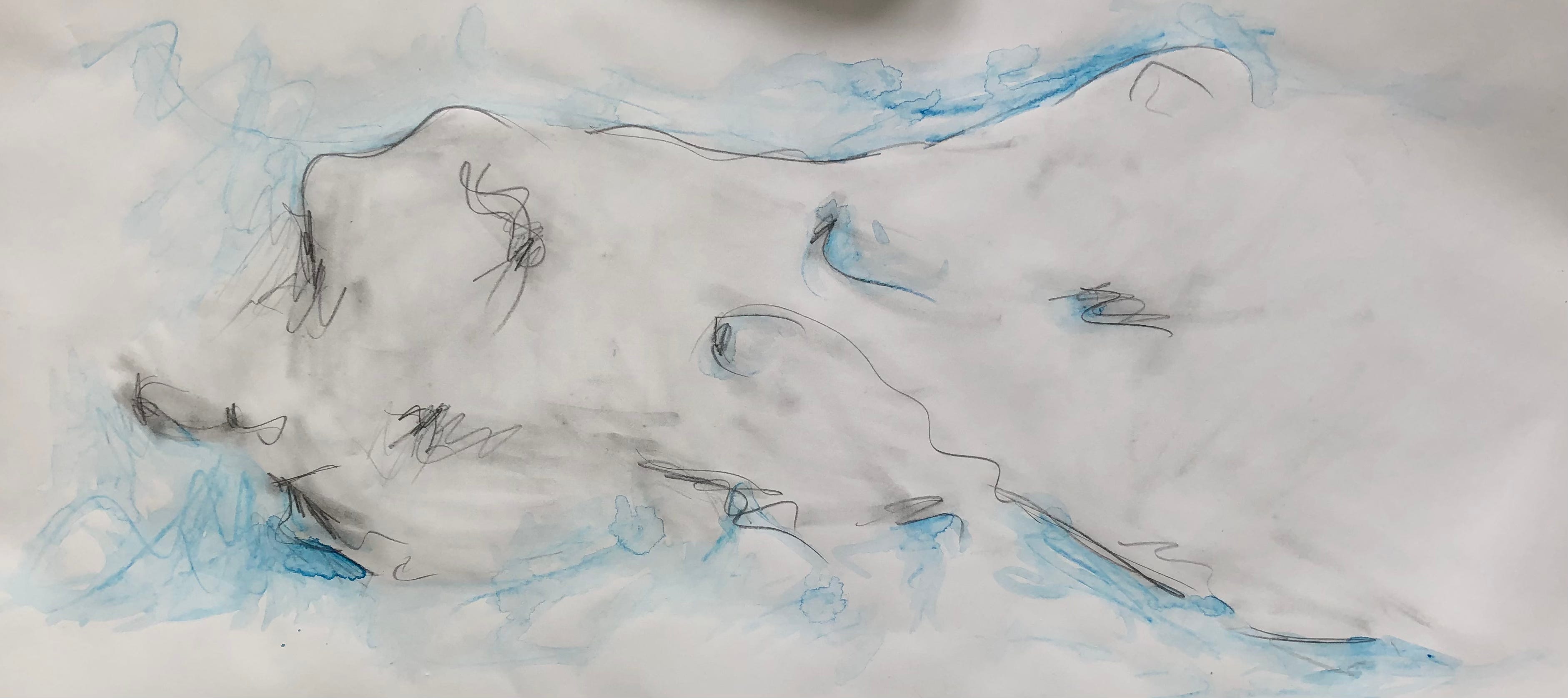
Occasionally I remember that what makes real artists real is the size of their work. But this is the first time (I think) I have acted on that knowledge. If I really understood myself, those close to me, and the media in which I sometimes attempt to realise my dreams, then I’d reproduce all these things as a gigantic pop-up book with drawings at the beginning of me, my wife, my sons, my writer and artists friends, the members of my son’s football team, my parents, the university admissions officers, etc etc. A pop-up book of disquiet.
On this train everyone is looking at their phones, just like me. Maybe they too are writing about recent aesthetic and professional breakthroughs. The woman sitting opposite me has exactly the same pair of running shoes as me (one of the older Nike ‘flyknit’ models; quite hard to find nowadays), but I’m not wearing mine. A young woman further down the train has the same pair of black Adidas tracksuit trousers as me, but I’m not wearing mine.
Everything is coming apart, of course. There is no present moment, just imagined futures built on greedily scavenged past ruins. When did the present, or the possibility of a present moment, end? I think it was sometime around 1993, maybe a little earlier.
If I had any literary energy (left) I’d write a brilliant text about Duchamp’s ‘inframince’ and the idea of ‘resistance’ in Freud. I’m almost at my station. Or I’d write a text about graphic design in Beirut during the 1970s and the influence of southern French typographers as mediated in Arabic text.
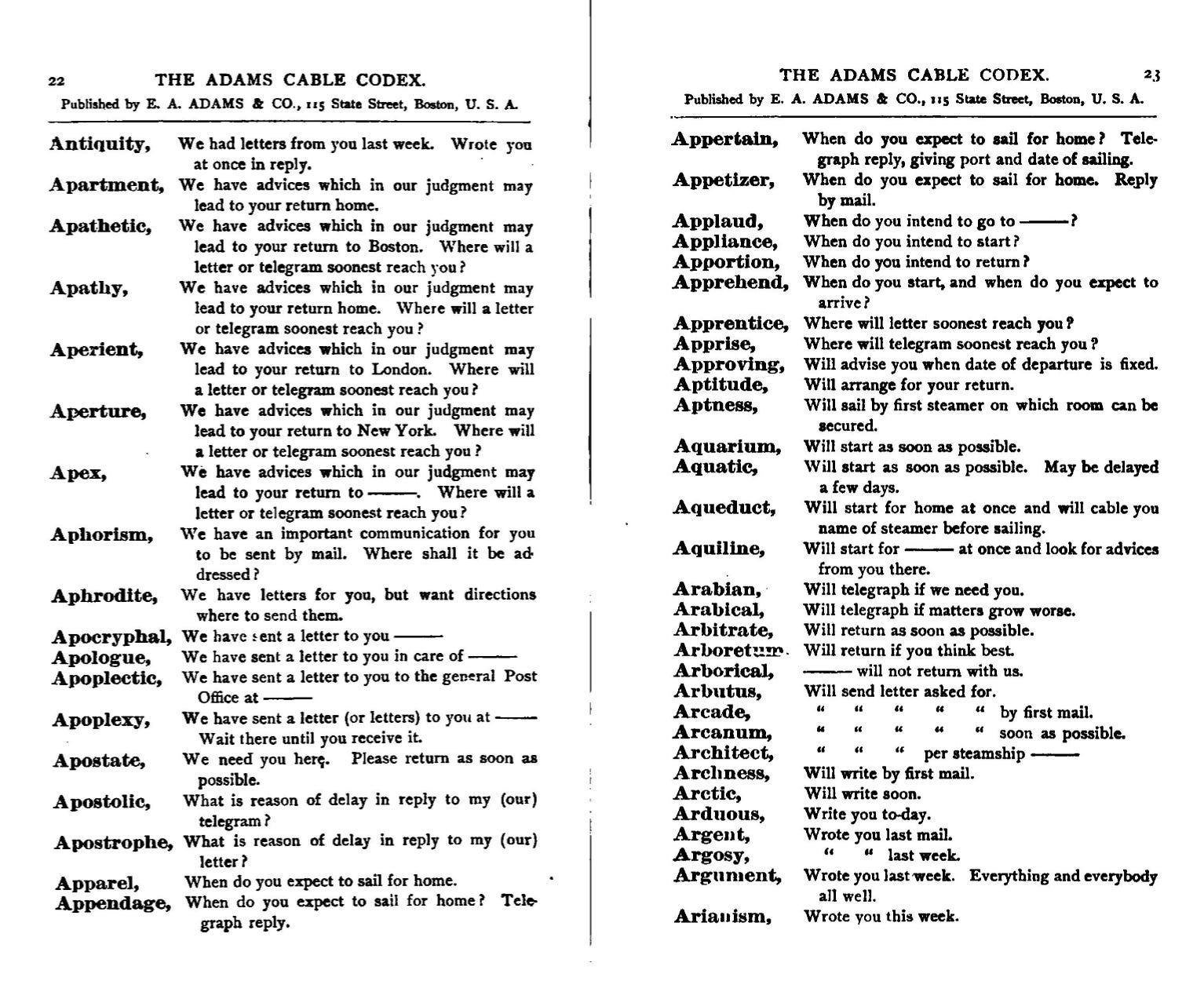
Things are coming apart, but they are being joined together in their fragmentation by the Belgian writer: he keeps writing texts where brusque sentences are joined as if by mortar(s) with the word STOP, like the violent punctuation of a telegram. STOP. He texts me to say that he needs to stop. All the bad news is unstoppable. We spent the summer sending each other pretty pictures, and now that it is term-time we send each other words of horror. STOP. But our friendship remains the same. STOP. The Adams Cable Codex from 1894 is a vast list of code words to abbreviate sentences or sentiments when writing telegrams. The code words are existing English words, usefully unrelated to the meanings they encode. ‘Closeness’ means ‘circumstances over which I (we) have no control’. STOP. ‘Iridescent’ means ‘what have you done? Write reply’. STOP. ‘Maritime’ means ‘looks like easy money’. STOP. ‘Martyr’ means ‘market affected by scarcity of money’. STOP. ‘Reparation’ means ‘have just learned the sad news’.
This weekend there are many art events, all conceived, curated, produced and performed by a relatively young phalanx of mysterious and earnest Europeans. The events form a loose festival called Lightning Strikes a Forbidden Orange Grove, and all combine unusual or quizzically provocative materials and technologies (saxophones, loudspeakers, wobbling sheets of plexiglass, melons rolling about on a snooker table, highly poetic solidarity with Palestine, texts about long-forgotten documentary filmmakers in the outer reaches of the Eastern Bloc, dressmakers’ pencils, barbed wire made from silk, Polaroids taken by resistance fighters at Syria’s beleaguered Roman remains, etc) with very cool, almost unreadable program documents and the use of locations whose addresses are not given out freely. They even arranged to have Stockholm’s most elegant, historic and prestigious cinema, Epauletten (colloquially known as ‘Axeln’, ‘the shoulder’), screen Hollis Frampton’s 1969 film Lemon. Because the projection was from a 16mm print and because Axeln’s screen is vast, there was a beautiful dispersal of the image’s grain, just like the dispersal of volatile oils when the peel of a lemon is cut. The film is only about 7 minutes long, so the use of such a grand cinema was extravagant. During the course of the film an off-camera light is moved in relation to the titular lemon so that its surface experiences a ‘day’ and a ‘night’, like a planet. It’s unclear whether this is part of a pun about the waning and ‘waxing’ of the light - when did mass-market citrus fruits begin to be treated with wax to improve their longevity and shininess? As early as 1969? The topic was not addressed in the program notes given out by the cinema ushers, an A3 photocopy with basic information about the film, a short essay by one of the festival’s curators, and some newly translated verses by the early 20th century Albanian poet Naïma Duda:
“On the center
of a spiral sat the resin,
while
In the park you,
You,
writing in your diary. Your collar was turned up, your
boots were worn out. Out,
out of its beak the bird spat the resin.
Nine, ten apples fell from the tree behind you,
You, unaware…”
I attempted to send an RSVP-request to one of the festival’s late-evening events, which was to be held in the abandoned rooms of a defunct chess club, but received a reply to say there was no space for me: the waiting list was full. If I wanted I could leave a telephone number, and they would send me a text message if a space opened up.
Just before receiving this reply I also received an email regarding an application I’d made for the modest travel expenses incurred when the Belgian writer and I met in Poland earlier in the year. All Swedish artists can and do apply for this money when travelling for projects. Anywhere they go, they expect the trip to be funded. Even travelling in a relatively roundabout way, visiting the French writer in Berlin and then taking a coach to the strange Prussian leftovers of Pomerania, leaving the time to write the strange iPhone notes that would diminish my readership to one person, perhaps a handful of people, staying in various different cities and consuming many meals of many kinds, it had been hard to account for enough money to meet the minimum amount allowed in the funding application. But I managed to reach the sum, and my application had been otherwise impeccable: the clear forging of artistic links between two if not three or four countries, an invitation written in beautifully courteous English by the renowned director of a publicly funded institution, meticulous accounting, the firmly established fact that I had to be there in person for the work to take place, and written testimony from Polish administrators that I would be looked after while there - all the Swedish funding body would have to do was to help with the travel expenses. And, while I may be ineligible and uncompetent in many other regards, I suppose I am undeniably a Swedish artist: I have Swedish citizenship, and it can be said and/or shown that I practice and/or produce art. Sometimes when speaking to artists from other countries they say “It must be great with all the art funding in Sweden?’, and I reply ‘Yes, there are some really good systems of support; funding for projects and for travel, and even a bursary system to pay for artists’ studios. Many artists and authors receive forms of rolling funding; grants that go on in perpetuity, allowing them the security to develop their practices and…’, but then I remember that I don’t receive any of these benefits. I’ve never once made a successful application for any of them. Unfortunately, my application for travel expenses for the trip to Poland was also rejected, on the grounds of it not meeting the standards required. The rejection letter explained that these standards are established according to three criteria: artistic merit, potential for artistic development, and financial need.
It’s very difficult for me to ask for things, especially ‘major’ structural or institutional things like funding. Such requests imply a planned and deserved future. Such plans require planning. I’m not completely inept when carrying out tasks themselves, but it’s hard for me to know what my tasks will be. I just react to small things, and react in small ways. I’ve been making pictures of clouds because they are there, briefly, and because my friend - the Belgian writer - likes clouds. It pleases him to receive images of clouds from me, and it pleases me to receive images of clouds from him. I haven’t intervened upon the clouds. My meteorological skills are not at a level that would allow me to apply for funding to paint specific clouds in advance of them passing, nor to report on the precise nature of the clouds if applying for funding in retrospect. I tend to just see clouds when they are there, sometimes. And then I had some sheets of blue paper at the studio, so I began drawing and painting the clouds on those - that way the ‘sky’ would already be there and I wouldn’t have to paint it.
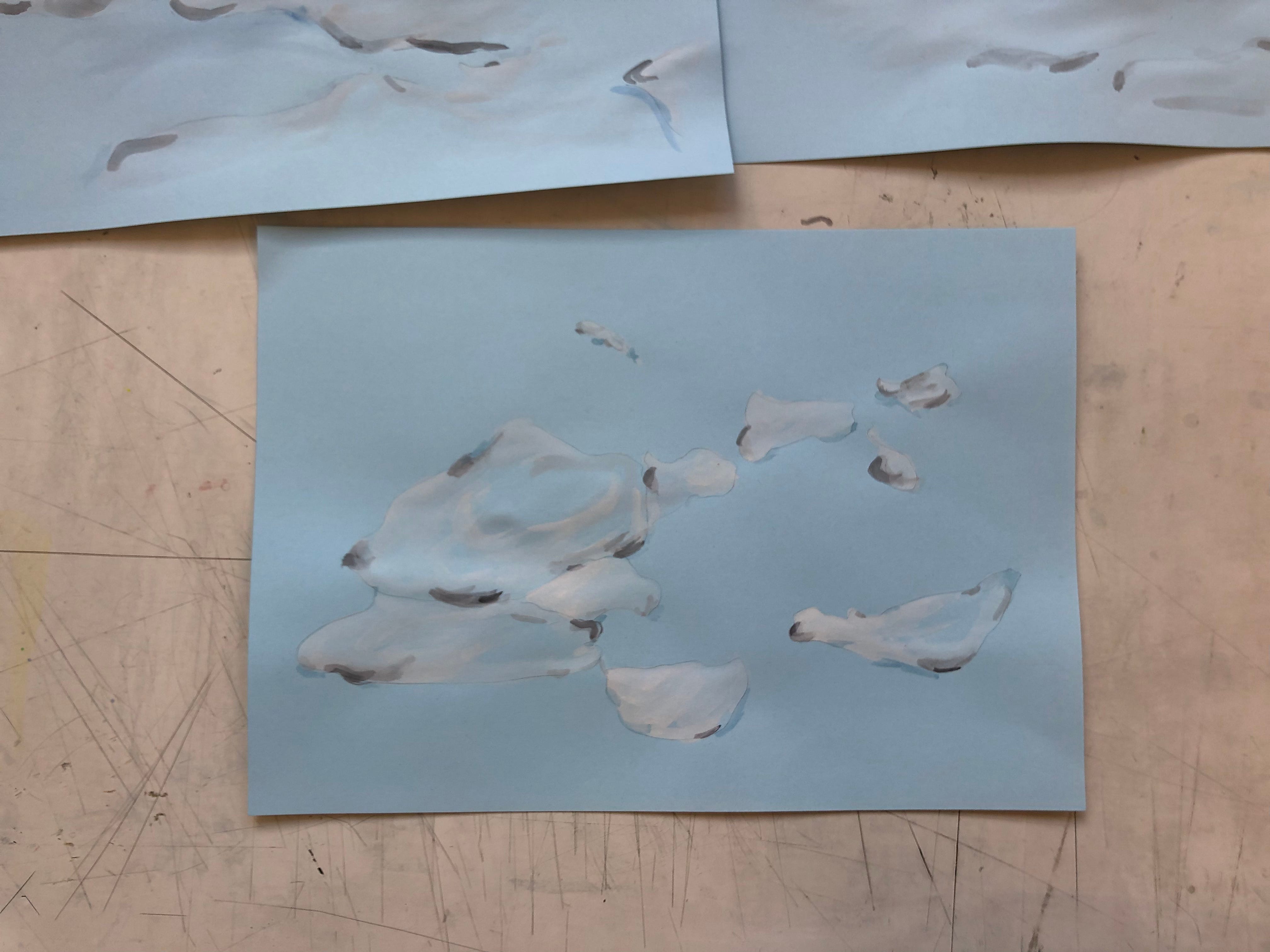
After a while, after making one of these pictures each day I go to the studio, of the sky outside visible from my table, I realised I could attempt to erase the pencil lines from them and leave only the white and grey patches of gouache.
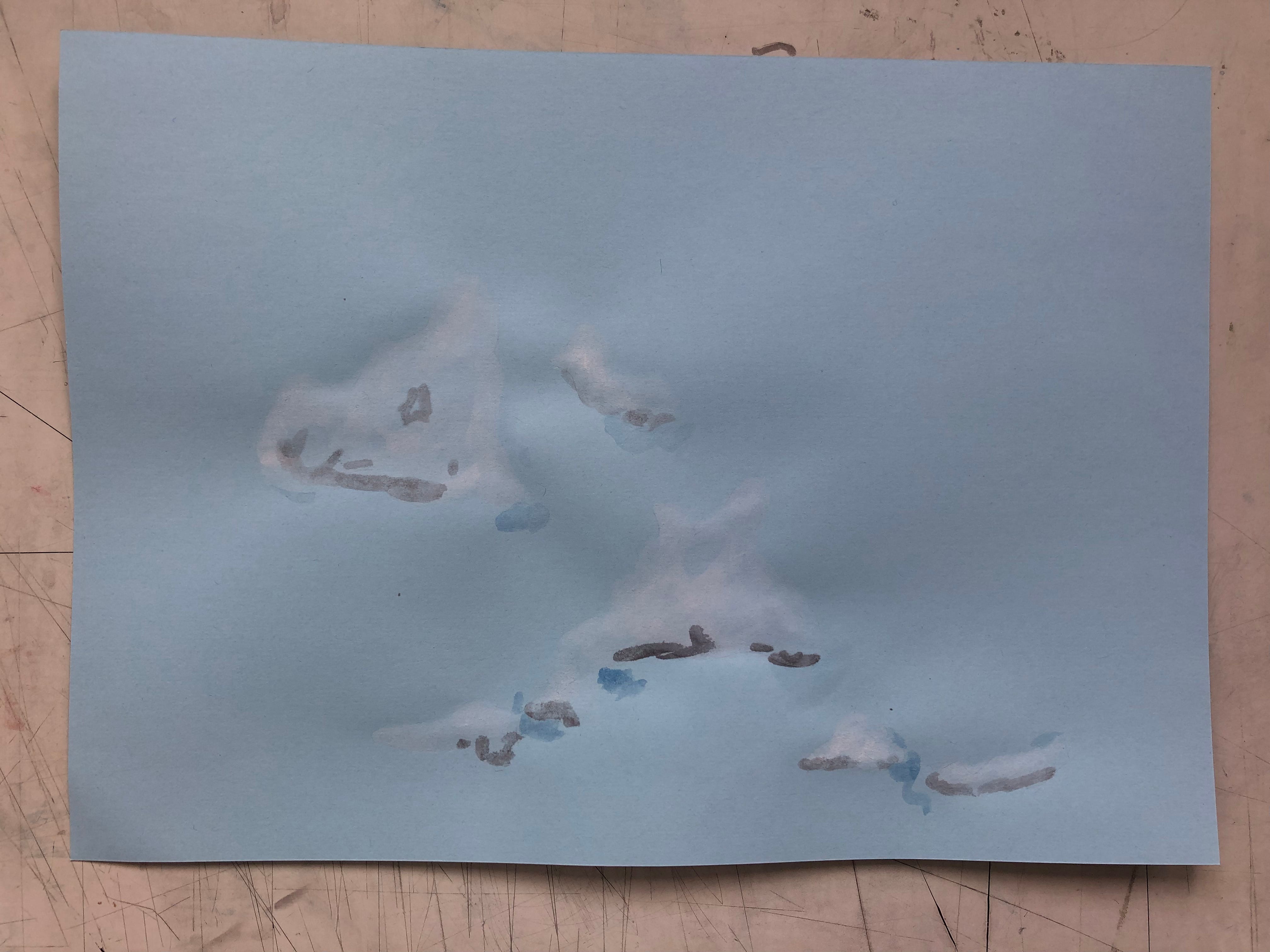
The difference between one of these pictures with and (nearly) without lines is negligible. Tiny bits of pencil remain sealed beneath some gouache, as if the design of the sky hadn’t been completely concealed. Like always, when seeing a notional ‘series’ of works, the odd person says to me something like “oh, will you exhibit hundreds of these together, a kind of cloud diary, an emotive meteorology, a link to cloud-observers of the past, Turner, Strindberg…?”, and I find it hard to explain that I’ll never have the opportunity or desire to exhibit hundreds of works together. It’s even harder to explain that what in fact will happen is that in five years I’ll have my next exhibition in some small room in a city where nobody knows me, Tbilisi or Rouen or Sheffield, that fourteen earnest people and the gallerist’s widowed mother will attend the opening, and that just one of these pictures will be exhibited alongside twelve other works that all look like they could have been made by different artists, each of whom is an earnest but baffling naive amateur.
I’m sick, finally, the result of concentric exhaustion factors: going to bed late, waking up early, shepherding children, being shouted at, having an unrealistic and poorly tessellating timetable, using several different languages badly throughout the day and changing between them often, eating strangely or forgetting to eat, going running too much as overcompensation for not having enough time to go cycling, wearing the wrong clothes for the weather, internalising the stress of earning no money yet wasting my time drawing and painting clouds.
My younger son says ‘along along ago’ to mean ‘a long time ago’. He confuses the terms ‘younger’ and ‘older’, and says that things he did as a small baby happened “along along ago when I was older”, or that I have a beard because I am younger.
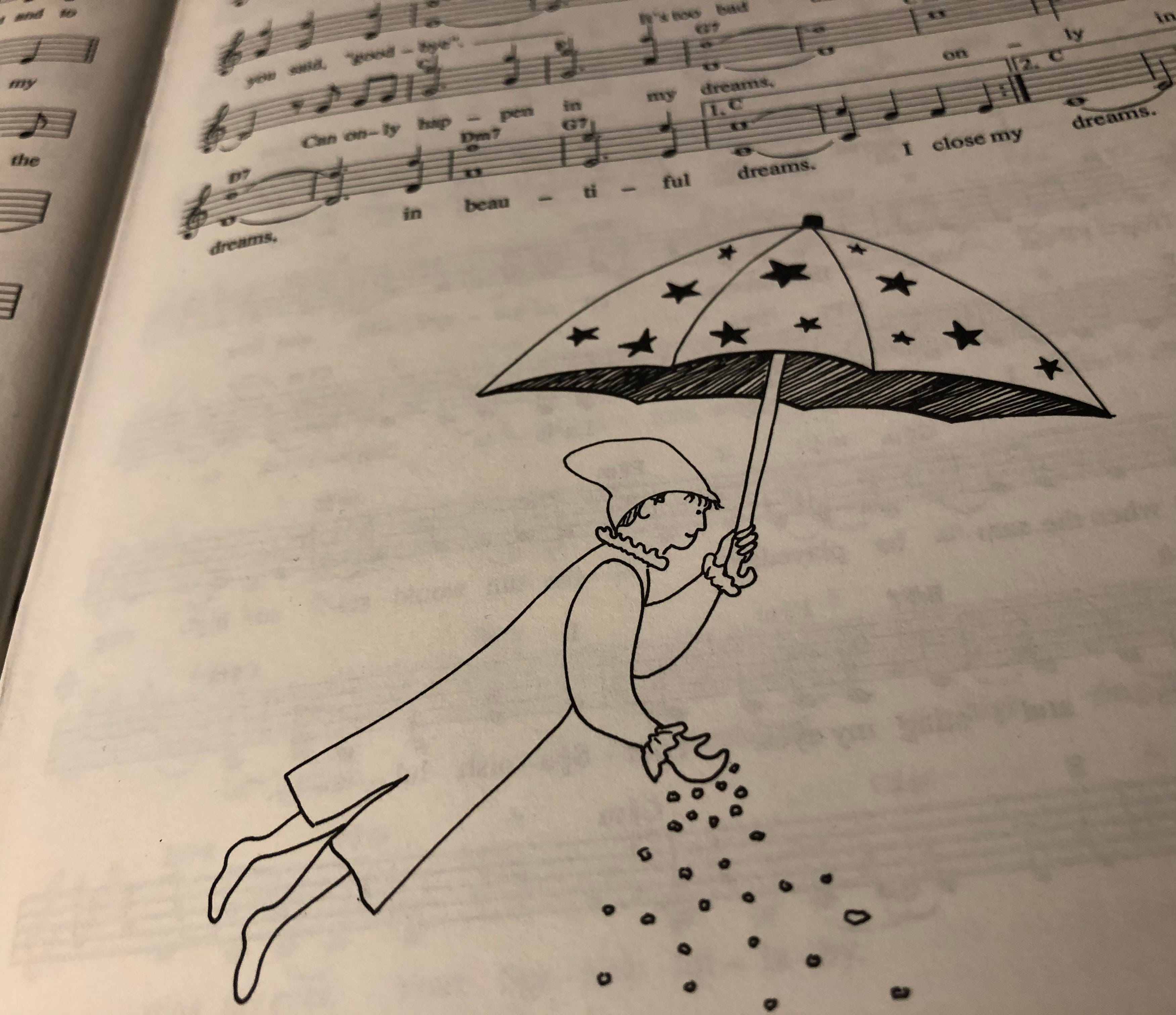
In the room where people leave things they don’t want any more my wife found a book of sheet music for songs that were in the Swedish charts during 1989. These include terrible pop and quasi-schlager songs in Swedish, rereleased classics that must have charted due to their inclusion in film soundtracks, international hits, and several Beatles songs. Each song is accompanied by naive or gently surreal illustrations. Since she brought the book home this selection of songs has formed my entire musical culture. During the odd moments I sit with the guitar I play certain of the songs over and over again, but in the wrong styles and tempos: ‘In Dreams’ by Roy Orbison as if it were one of the catchier Pavement songs, ‘Killing Me Softly’ by Roberta Flack as if it were one of Scott Walker’s Jacques Brel covers, ‘Helpless’ by Neil Young as if it were a John Dowland composition, or ‘Eternal Flame’ by the Bangles as if it were somnolent 90s trip-hop.
Sometimes it’s tricky when one’s main objectives or ‘aspirations’ are to do things of very limited value or worth (achieving a way of minimally recording impressions of clouds, for example). Other people are working hard, and many or most of them can know, even at difficult moments, that they are making some kind of contribution or investment or progress. They may even be receiving financial compensation for their work, either now or later, or may receive validation for their efforts in the form of approval from superiors or obedience from inferiors, or through camaraderie with their peers. Even if their work is difficult or unpleasant they can think ‘at least I’m paying the rent’, or ‘at least I’m helping people’, or ‘at least I’m feeding my children’, or ‘at least I have some kind of role in the world’. I’m not too sure about validation; how it works or how it can be used, or if it simply an idea (it has no physical substance). But I received a modest amount of it myself earlier this summer, when I did a small exhibition in a curator friend’s apartment. Around ten people told me, unambiguously, that they thought the exhibition was ‘good’. I thanked them for telling me that, but didn’t quite know if or how I should continue the conversation, or the resultant thought process.
It’s really nice to be writing for just one reader; to be writing as unlike a ‘writer’ as possible. I’m writing this just for you! Not even for myself, just for you! Perhaps I am doing this so that ‘approval’ might come in a form so small and localised that even I can recognise it?
I get more sick and delirious by the day, and it’s impossible to find adequate moments to rest. Absurdly, yesterday I was the only coach for my son’s football team. Usually there are at least two or three of us present, and the other coaches have a degree of authority - the players listen to them. The team were playing an away match against some big, strong, white blond boys, suburban farmer’s sons that could have come from any time in Sweden’s history (and perhaps had, if this was some kind of Time Rangers situation). I set out what seemed, in my fever, to be sensible tactics: to play cautiously, not over-commit in attack or try anything too intricate, to absorb pressure and instead of throwing players forward counter-attack using our quickest player (who never passes anyway) as a lone striker, and our most sensible player (who always looks up and passes, usually wisely) as a midfield fulcrum. Within the first 20 minutes we were losing 10-0, and it became clear that I was presiding over an unprecedented disaster. The other team were by now laughing each time they scored. My players were disconsolate and frustrated, and initially looked to me for guidance. I changed the formation and swapped players around. The score got to 15-0. It was evident that I had lost any respect I might once have had from the players, and perhaps even their watching parents. I was sweating heavily, illness indistinguishable from stress, and my throat was getting more and more sore - during the final, post-match team talk I had lost my voice so thoroughly that some words came out comically high and squeaky.
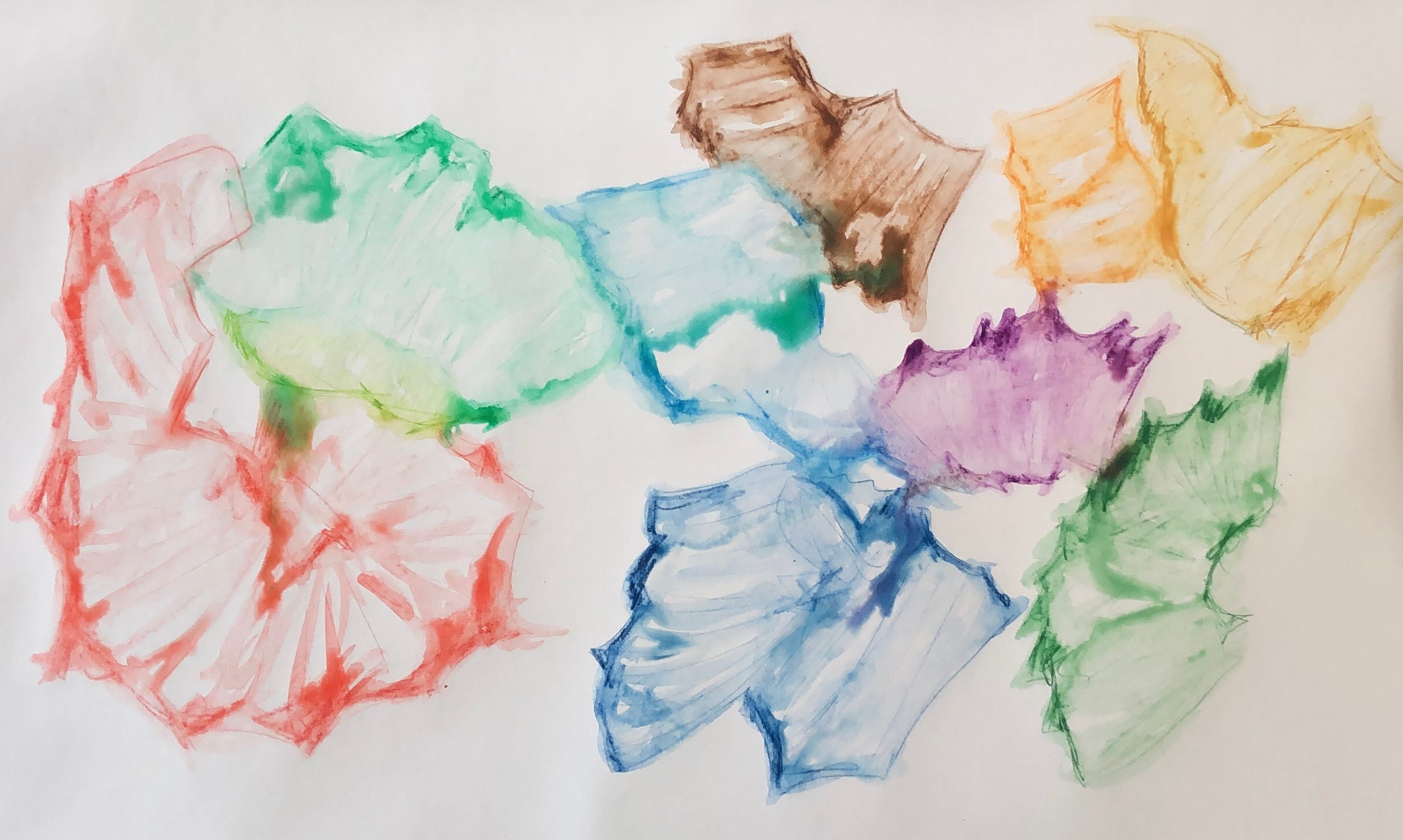
I have been sharpening my watercolour pencils, drawing the pencil shavings with their respective pencils, then roughly adding water with a too-large brush.
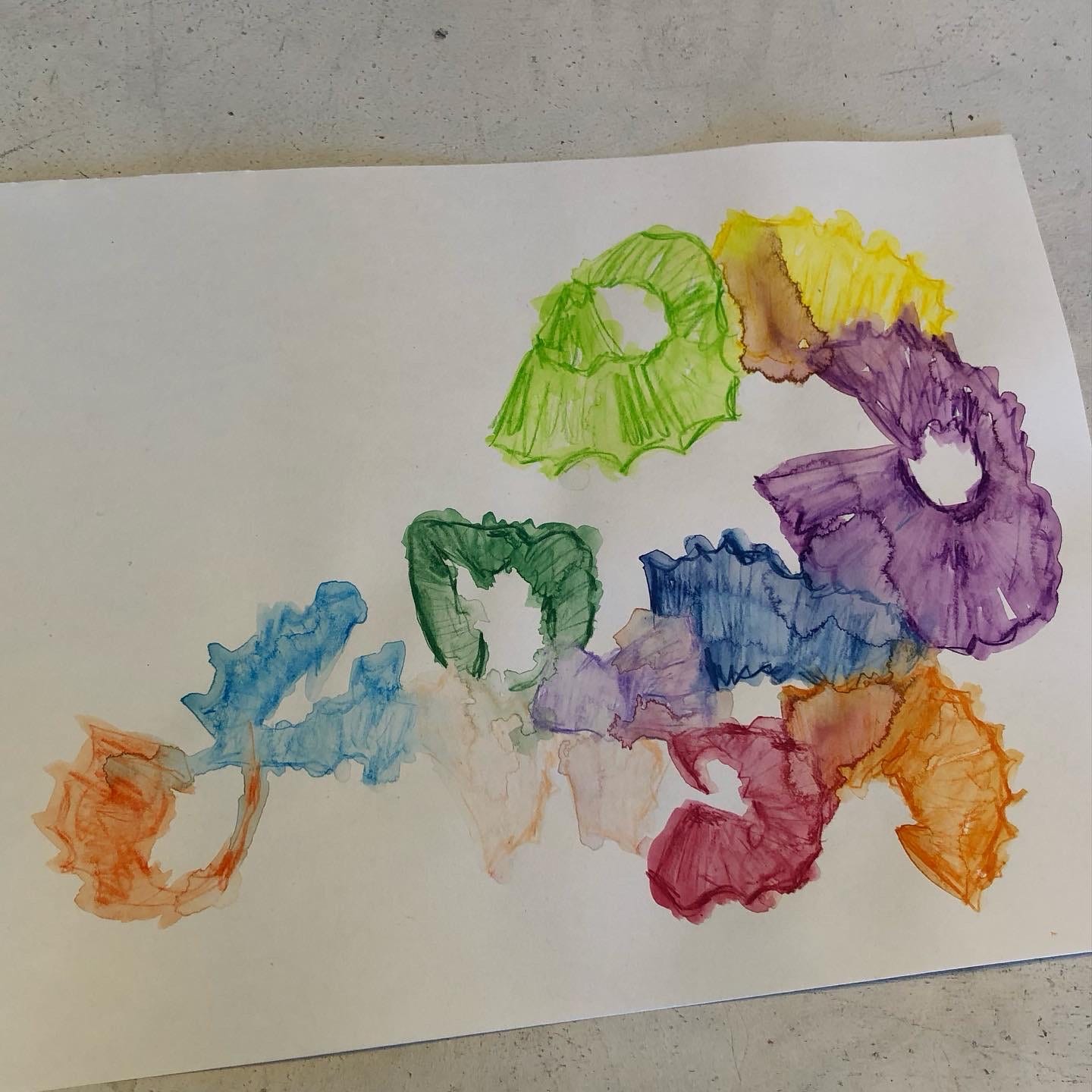
The results are ‘arty’ rather than ‘artistic’, despite the nominal conceptual rigour (ie. closed circle, or spiral) of the work: the pictures look like they were made by a nice older lady at an adult education evening art class in a provincial town. The lady in question might even wear silk scarves that look like these pictures. Perhaps that is a form of education that would accept me. I wonder if I could apply for such courses already, or if I’d be disqualified by my youth? Am I retired, or do I have to wait until I reach the requisite age to receive a state pension? Perhaps then I’ll be able to enter a suitable form of education.
I have also made a huge iteration of this method on another length of white wallpaper, perhaps a metre and a half wide. Children are not allowed to draw or paint on wallpaper - they get told off if they do so. It would seem that the one adult privilege I have acquired, or achievement I have made, is to have established conditions allowing me to defy that norm.