Försvara

Back in the zone of shopping centres, in one of the many screening rooms of the gigantic multiplex cinema, the adverts before the Minecraft film offer reassuring visions of life in Sweden: the wide variety and availability of dairy products, the wide variety and availability of building materials for new and to-be-improved houses, the availability of burgers made without meat but also burgers made with Swedish meat, the important role played by McDonalds (as Sweden’s largest employer of ‘youngsters’) in giving people a good start in life, and a propaganda film about Sweden’s agency for cyber-security, Försvarets radioanstalt (the ‘defensive radio institute’). The propaganda film shows many of the same things as the other adverts, but also reminds viewers that these things (which are the fruits of democracy) are only available due to cyber-vigilance.
People eat popcorn, nachos (sometimes written as ‘nacho’s’, and sometimes pronounced ‘natchoss’), and they eat sweets. As well as the sweets available in the foyer of the cinema there is, elsewhere in the shopping centre building, a sweetshop that boasts a range of 1200 different sweets. People drink very large cardboard cups of conventional soft drinks or, in the case of the older boy, a ‘frozen Fanta’. This hybrid confection combines the texture and temperature of a ‘slushy’ with the fizzyness of unfrozen (i.e. normal) Fanta.
The propaganda advert intercuts between scenes of everyday life in Sweden (white hikers atop a rocky outcrop, a man of a different ethnic origin waiting at a bus stop, a father teaching a small girl how to cycle; his pride at her learning to cycle is one with how safe he feels due to surveillance) and scenes of the work done to preserve such life (the constant monitoring of Swedish data).
The Minecraft film stars the actor Jack Black, a man whose name rhymes, who shouts (or exaggeratedly whispers) rather than talks, and who has a large chest. The older boy thought that the film was incredibly good, perhaps the best film ever made. Jack Black’s co-star, Jason Momoa, also shouts and has a large chest, but his name doesn’t rhyme. After the film, almost every member of the audience left their popcorn containers, drink mugs and sweet wrappers and bags on the floor next to where they had been sitting. Other people will clean it all up. Out of the cinema and in the main part of the shopping centre there was a man whose sweater (a ‘hoody’, or ‘hooded sweater’) bore the message ‘ASSHOLES LIVE FOREVER’.

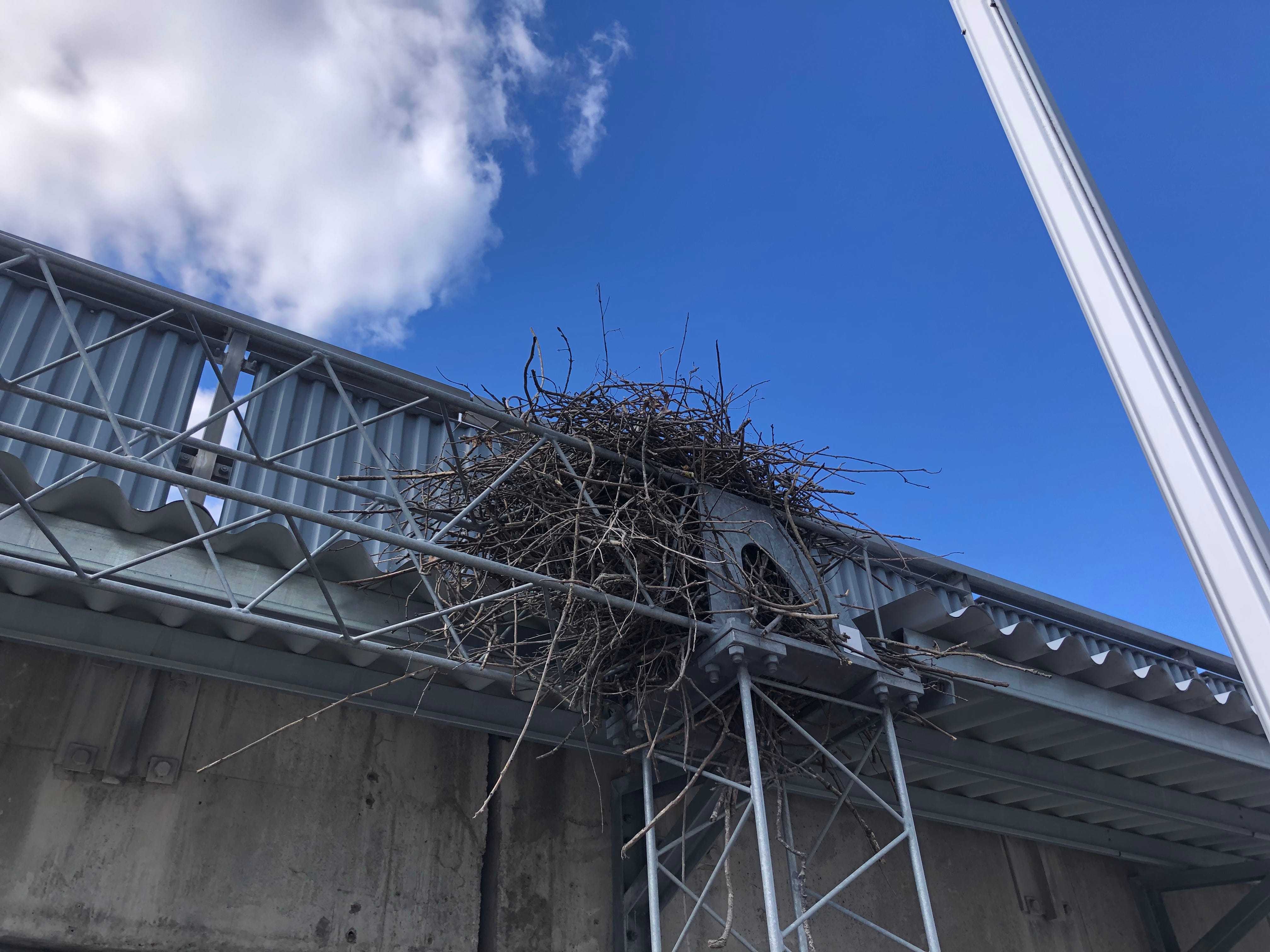
To return home meant crossing a large tarmac area separating one shopping centre area from another. This area is encircled by stones, and desolate. It is an ‘overflow car park’, to be used when the other car parks are full. At its edge there is the main car park. One of the car park walls is lined with scaffolding, where some enterprising birds have made their nest (insert facile/clever analogy to the mise-en-construction theme of the Minecraft film).
Sometimes there are periods of time where ‘life’ (understood in some loose narrative sense, the way a person might describe their life and its status, progress and texture) is merely maintained. There are no new inputs or outputs. Novelists use metaphors like ‘treading water’ or ‘being in a holding pattern’ to describe such interludes. If the subject has a tendency to ignore long-term issues or ambitions (having no career, reliable income or capital, either financial or professional/cultural) and pursues only short term and temporary goals (washing dishes, going on bike rides that begin and end in the same place, photographing the same things day after day, week after week and year after year, ensuring that the same meals are cooked over and over again), then it is as if they are attempting to enforce a kind of stasis in a world that is dynamic and changing. There is ample evidence of this external dynamism: the season appears to have changed (from winter to spring), Nintendo are releasing a new console (the Switch 2 will succeed the Switch), friends are honoured for their achievements (hard work paying off), Israel continues to eradicate Gaza, Western politicians casually chip away at the illusion of liberal democracy, and children acquire new skills, vocabulary and independence. But here everything is still, and interfaced. The younger boy is watching Hey Duggee on a phone, his brother is using his iPad, attempting to acquire Gareth Bale for his online football team, their mother is planning a running club event on a phone, and their father is writing, on yet another phone. On the kitchen table there are three pots containing at least one hundred felt tip pens, a plate on which cress is growing, a small chilli pepper plant grown from seed by the older boy at school, a large amount of leftover Easter decorations and paraphernalia, and there are tissues, glasses of water, a paper boat, a candle stick, smears of yoghurt, and a tin containing many packets of seeds. The seeds should be planted in a box in the communal garden and playground area, but they require new soil. The old soil must be dug out and taken to the garden waste area.
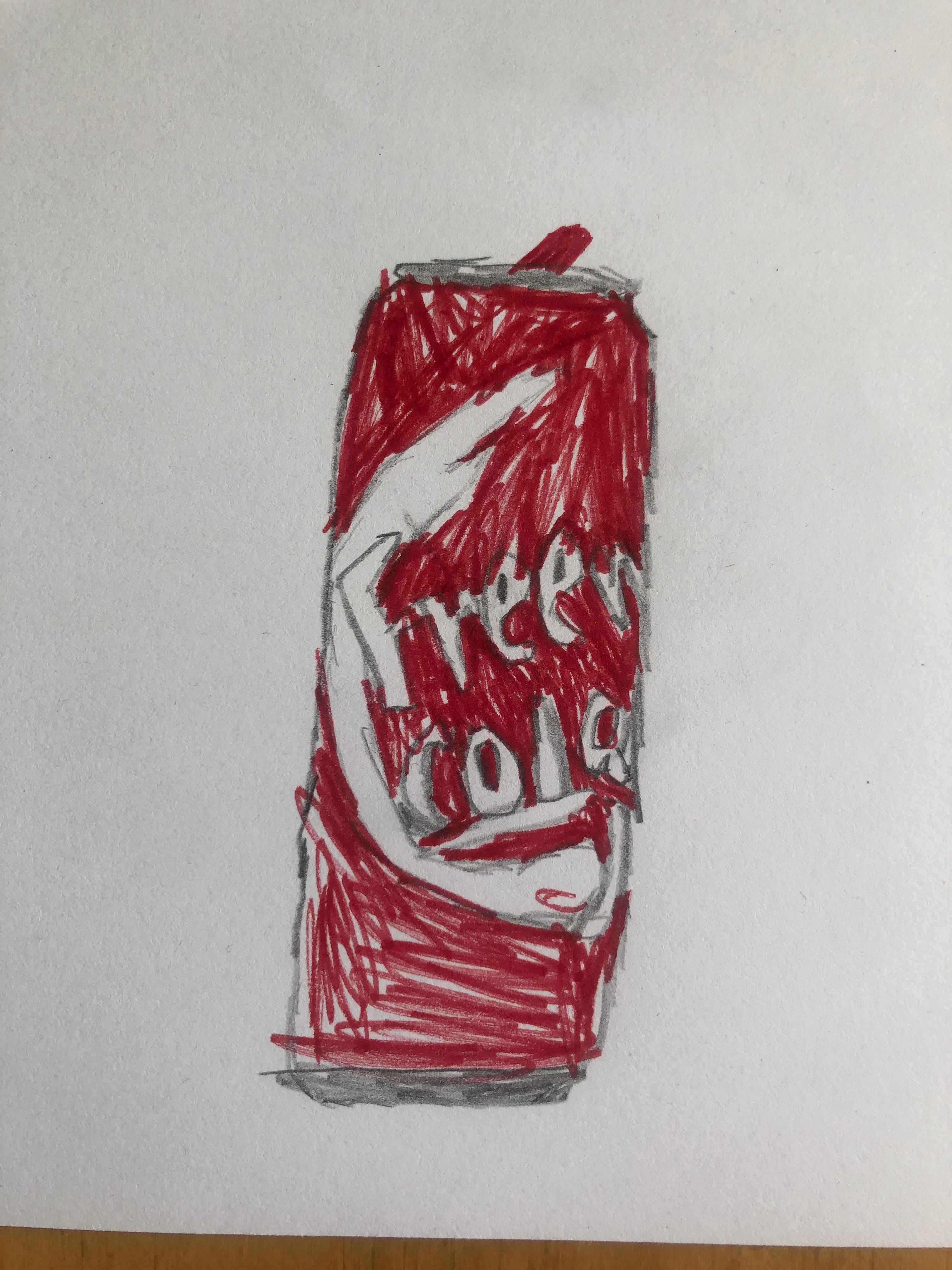
The older boy made a drawing of a can of ‘Freeway’, the proprietary cola of pan-European supermarket LIDL.
Don’t forget that texts, words, language, prose, poetry, and especially the iterations of these things in English, are of little value. There are certain texts that are widely read (the works of bestselling authors), but the value of the text itself is low in these cases; the most popular texts are badly written, and the better-written popular texts simply pander to the vanity of writers and readers alike. The nominal value of text increases in less-read texts, but remains low. Words are worth nothing.
The French writer explains that the reason this text seems to have halted (it hasn’t been supplemented for weeks, and even before that its writing process had been sporadic) may be because of the need for the mind to ‘rest’ or ‘take a break’. The suggestion is that the production of ideas is tiring. But were ideas being produced?
Even after some time spent tidying, the living room is still a wild cascade of vehicles, members of the Paw Patrol, books, Lego and Duplo pieces, bouncy balls, jigsaw puzzles and, above all, dust. There is dust everywhere: on video game controllers, pencils, boxes, magazines, musical instruments, loudspeakers, screens, papers, chairs and cabinets.
The sky is blue - ‘a nice day’ - but there is a howling, freezing wind outside.
The most prestigious art school in Caracas is launching an MA course in Meteorological Poetics. The most prestigious art school in Geneva is launching an MA course in Frontier Consciousnesses. The most prestigious art school in Lagos is launching an MA course in Fiscal Subjectivities. The most prestigious art school in San Diego is launching an MA course in Playful Epistemologies.
It is possible for the mind to shut down almost completely but for the host self to be quite happy. It is like the exhaustion felt following a defeat, but there was never any competition.
The living room is covered in jigsaw pieces and helicopters. The smaller boy is watching Paw Patrol - The Mighty Movie, and his older brother is watching video clips of football players fighting with one other. Their mother is exhausted because she has a full time job, a real job, and this is a ‘day off’. On the cabinet below the television there is a large herd of My Little Ponies (of My Little Pony ponies?).
Meaning and truth, of course, have been completely evacuated from life on Earth. Quite openly, and with the full support of powerful allies who have always thought themselves to be on the side of good and of progress, Israel continues to decimate life in Gaza. They are also fully supported by Germany, which used to practice genocide itself but now sees itself as being on the side of good and of progress. As well as killing people directly, Israel also wants to destroy the feasibility of future (Palestinian) life in Gaza. At the moment they are ensuring that the people there starve - perhaps for tactical reasons, perhaps as an experiment, perhaps just for fun. They are also denying hospitals the means to care for their patients. Sometimes, when they feel like it, they even kill doctors. Sometimes the surviving doctors of Gaza give distraught and tearful testimony about the attacks on their hospitals and, ultimately, about the profound emotional apocalypse experienced by a doctor who is forced to let suffering people die, or who can do nothing but watch as the power cuts out and the incubators keeping premature babies alive just switch off. Sometimes other people call these doctors liars and terrorists, or say that they just run their hospitals as places to host and conceal terrorists. Most of the time the definition of ‘terrorist’ goes unexamined. Sometimes Israel kills the journalists of Gaza, who tell people about what is happening there. In any case, everyone knows that all this is going on: people in Gaza, people in Israel, people in neighbouring countries, people in countries far away, people who support them and people who despise what they are doing. Nothing is concealed, except perhaps even more terrible things that we don’t know about.
Aristotle is extremely clear and sure of himself when describing how tragedy works. He writes that ‘Fear and pity may be excited by means of spectacle; but they also take their rise from the very structure of the action… the plot should be so ordered that even without seeing it performed anyone merely hearing what is afoot will shudder with fear and pity as a result of what is happening.’
The smaller boy has begun conflating the lyrics to the Lou Reed songs ‘Legendary Hearts’ and ‘Tell It To Your Heart’ - an easy mistake to make. It must be difficult for a three year-old to disaggregate the various heart metaphors of Lou Reed’s turbulent 1980s, but he will learn. He sings “Tell it to your hearts, legendary frayed” instead of either “Tell it to your heart, please don’t be afraid” or “Legendary hearts, tearing us apart”. We have been watching the video of Lou Reed’s performance at a 1987 concert for Amnesty International. Against a stage set representing the buildings of New York City, Lou Reed sings ‘Tell It To Your Heart’, with Peter Gabriel playing the electric piano and smiling beatifically. Two percussionists play djembe drums, and a man with an astonishing mullet haircut plays a searing saxophone solo. Lou Reed wears a leather jacket with tassels. The lyrics to ‘Tell It To Your Heart’ contain a perfect haiku that describes Lou Reed, both at a specific moment and in general:
‘I ran outside down a darkened street,
Listening to my boot heels click.
My leather jacket squeaked, I needed a cigarette.’
He wore a lot of leather during this period:
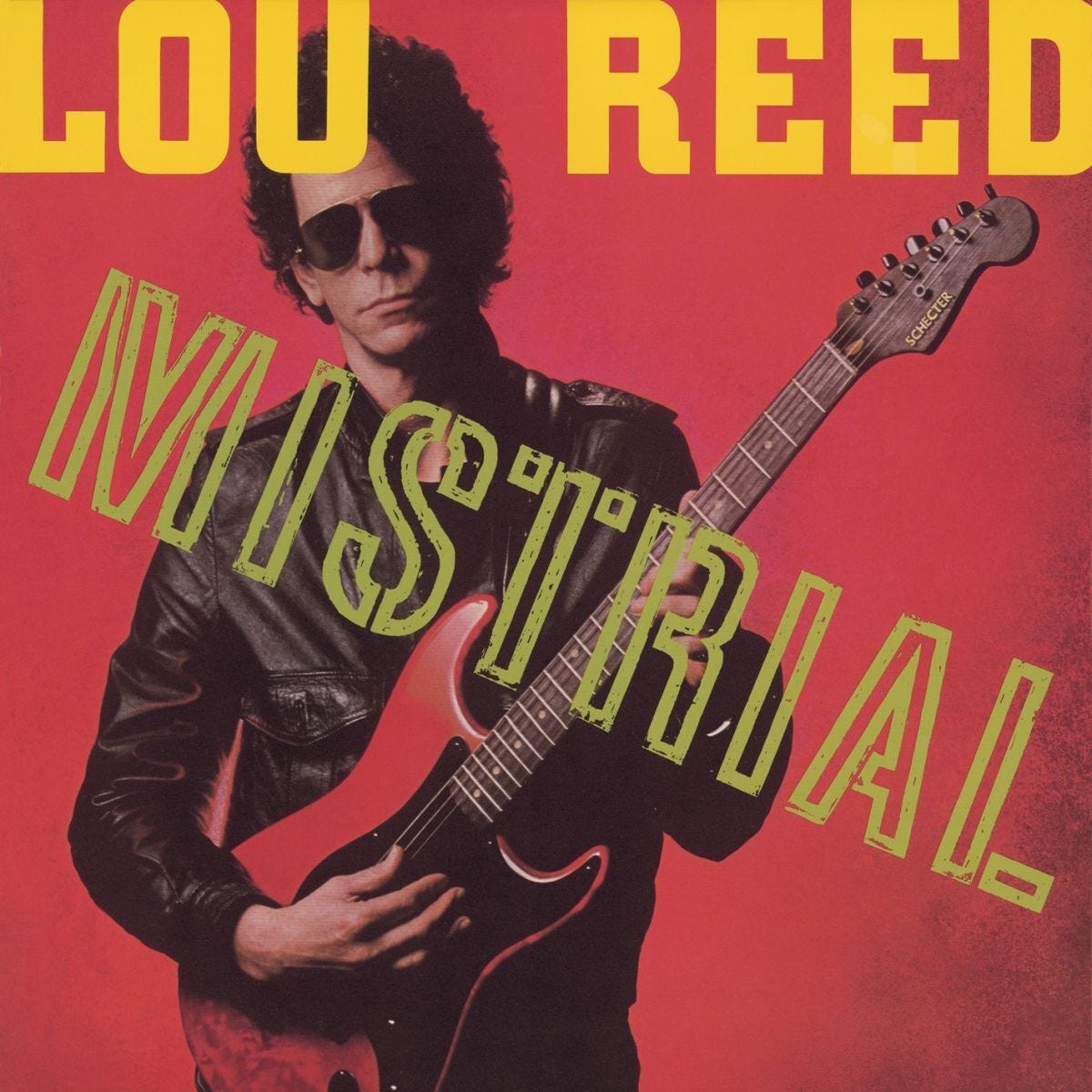
In fact, these lines from the song are almost every possible kind of text at once: poetry, prose, information, story, scenario, synopsis, fact and fiction. The only thing they are not is tragedy. In one of the first-person iPhone notes that precede this one there was an account of how confusing it was to discover that the Lou Reed album Mistrial was not, in fact, called Mistral. Perhaps things would have been very different if it had been called Mistral, or if the cover of the record had at least used Roger Excoffon’s ‘Mistral’ typeface:
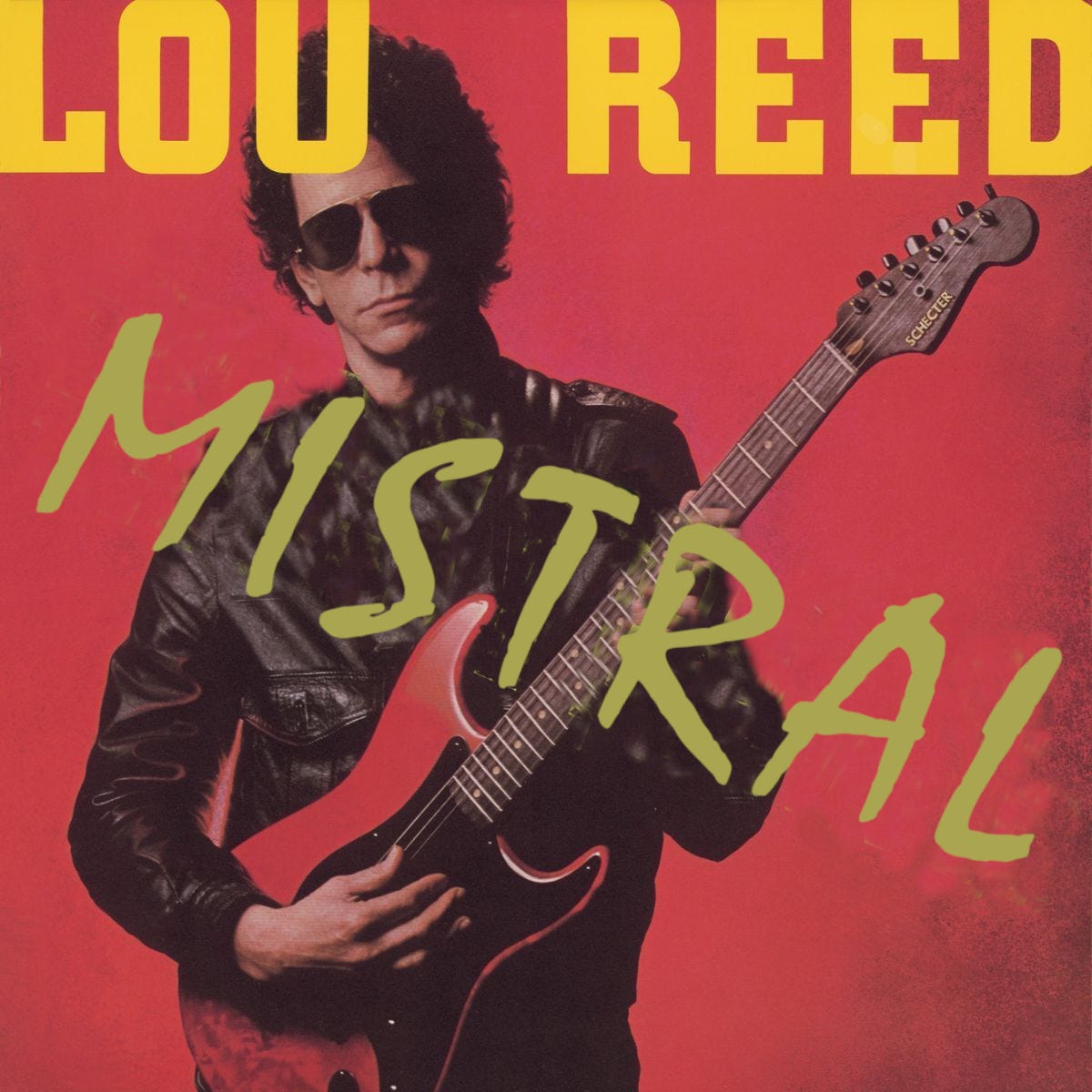
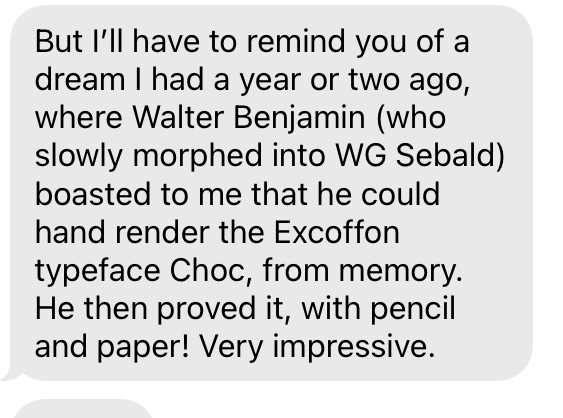
It’s almost strange that it didn’t, because the designer - Sylvia Reed, one of the great unrecognised geniuses of album cover design - was especially virtuosic in her employment of cursive typefaces. The English artist and designer remembers a dream:
The ‘Mistrial’ album is generally maligned by critics, and is quite forgotten in rock history. Some of the songs are pretty bad, on the surface, but the album ends brilliantly (perhaps it endured a mistrial). The penultimate song, ‘I Remember You’, says almost nothing, but does so with weirdly joyful repetition:
“I remember you, I remember me,
I remember, I remember how things used to be,
I remember every word that you said,
I remember, how could I forget?
Yes I remember, I remember you,
(I remember, I remember)”
The memories are no more specific than that - he just says that he can remember things. He’s really just saying that he has memories. He can remember specific unspecified things. But then the final track is ‘Tell It To Your Heart’, which is composed of incredibly specific memory images.
‘I’m standing by the Hudson River’s edge at night,
Looking out across the Jersey shore,
At a neon light spelling out some cola’s name,
And I thought your name should be dancing,
Beamed from satellites,
Larger than any billboard in Times Square’
It is, admittedly, a pleasant relief to copy and paste pieces of text full of the word ‘I’. This word, along with ‘me’, ‘mine’ and ‘my’, remains forbidden in these iPhone notes. Perhaps if it had been allowed then this note wouldn’t have stalled and fragmented so much; perhaps all the things missing from it required a solipsistic first person perspective, and without this perspective they could never find expression. But it would feel shameful to return to the near orbit of ‘I’. Perhaps the next step would be to shed some more layers, to avoid ‘we’ and ‘us’, and ‘he’, ‘she’ and ‘they’ - to avoid writing about people at all (not even Lou Reed) and describe only objects, events and related phenomena. To forget about identity completely.
A neon light spelling out some cola’s name would be a really great lazy conceptual art proposal: it’s a feasible instruction to be executed by a curator or art institution (would they choose Coke or Pepsi? Or Freeway? Or some long-forgotten or recherché brand? Or would they, cleverly, have the neon spell out ‘some cola’s name’?). It would express a kind of late-capitalist fatigue as well as an implicit critique of artists who, bereft of other ideas but with an instinct for intense but falsely modest monumentality, just have a deadpan word rendered in neon.
Amnesty International are unequivocal in their analysis of Israel’s actions in Gaza:
“Israel has continued to commit genocidal acts, fully aware of the irreversible harm being inflicted on Palestinians in Gaza. Any move by Israel to displace Palestinians to the south of the Gaza Strip and confine them into so-called ‘closed bubbles’ or continue to impose inhumane conditions of life to push Palestinians out of Gaza, would amount to the war crime of unlawful transfer or deportation. If these actions are committed as part of a widespread or systematic attack directed against the civilian population, they would also constitute crimes against humanity.”
Closed Bubbles would be a terribly sad title for a conceptual sculpture acting as an oblique monument to ongoing genocides and the misinformation surrounding them.
Aristotle writes that ‘Every tragedy has its complication and its denouement. The complication consists of incidents lying outside the plot, and often some of those inside it, and the rest is the denouement. By “complication” I mean the part of the story from the beginning to the point immediately preceding the change to good or bad fortune; by “denouement” the part from the onset of the change to the end.’
This note has suffered without the presence of ‘me’ because it has also been a very emotional time, which it is almost stupid not to write about. A writer would have found a way to write about those emotions anyway, obviously, rather than pursue experiments in circumscription.
The most prestigious art school in Honduras is launching an MA course in Memories of Care. The most prestigious art school in Belize is launching an MA course in Critical Wisdoms. The most prestigious art school in Lichtenstein is launching an MA course in (T/Pr)actical Ontologies. The most prestigious art school in Nepal is launching an MA course in Life Drafting.
The ‘Mistral’ typeface is generally maligned, by unthinking critics, for its extreme overuse and ‘cheapness’, or its association with cheap things, cheap products, cheap businesses, restaurant signs with spelling mistakes; for the vulgarity of its uses. But of course it is beautiful because of its sincerity. The handwriting of one cultivated man (Roger Excoffon), in specimen form, kept alive even in metal type, gives expression to uncultivated life (and actual pleasure). It is the typeface of getting a haircut, ordering a lemonade in a cafe, browsing a local newspaper, looking out and seeing a window cleaner’s van going by, then maybe going to a record ship to buy Mistrial by Lou Reed, perhaps even wearing a leather jacket. It is free expression from the 1950s, persisting into the 1980s, like doo wop music or abstract painting. Or instead of ordering a lemonade, maybe even ordering a diabolo grenadine, on holiday in Normandy in 1988, wearing purple jeans, reading a comic, making friends with some local kids and playing table football.
Aristotle also writes that ‘the marvellous should of course be represented in tragedy, but epic poetry, where the persons acting the story are not before our eyes, may include more of the inexplicable, which is the chief element in the marvellous.’
The prevalence of syrups for flavouring coffee, especially since the late 1990s or so, actually means that many cafes in France are theoretically capable of producing many kinds of diabolo, not just grenadine. Next time, why not try ordering a diabolo noisette, or diabolo cannelle, or even a diabolo banane - they’re all delicious. The waiter might be confused, disapproving even, but you can simply reassure him that you know what you’re doing, that you take full responsibility for the results of your request. Tell him it will be fine. Nobody, as yet, in the history of France, has dared to order a diabolo Pastis (a so-called diabolouche), but perhaps this summer will be its time. It could be you that crosses that final frontier of refreshment. Imagine: you are sitting outside a cafe in hot weather, but you have the shade of a parasol, a notebook, some coloured pencils, and a copy of a new children’s book explaining the work of Marcel Duchamp (Les aventures de l’inframince by Salome St. Style, with illustrations by Denis de Nîmes). The waiter approaches, and you order the diabolouche. He raises an eyebrow, defensive, nervous, concealing his excitement. His heart is beating faster. You explain the specifics: a measure of Pastis in a tall glass, a small bottle of lemonade, a rounded beer glass filled with ice cubes, with a small pair of plastic tweezers. He sighs, emits a tiny moan of suppressed pleasure, glances up at the postman passing by, the boy playing with a spinning top on the stone steps of the church, the village librarian trying to start up their moped, the mayor placating his crying mistress and the old German man studying a map at the table next to yours. A few minutes later he returns with your order, lingering to watch you place the first few ice cubes into the Pastis and then gently pour in half of the lemonade. He takes out his notepad, but no further order has been placed: he records the moment with a quick sketch.
The hallway is, momentarily, tidy. The living room is, momentarily, tidy. The kitchen is, momentarily, tidy. There is a kind of gratin dauphinois in the oven (it has potato and sweet potato, and scatterings of fried leek in a mustard reduction, but is otherwise normal, immersed in cream). On the big table in the living room there are drawings by four different people, as well as an atlas, felt tip pens, some maths homework, candlesticks, headphones, inexplicable little plates and saucers, some books, and many, many bookmarks.
Sometimes a certain garment becomes so deeply ingrained into one’s life that it begins to feel unnatural not to wear it. Some black Adidas sweatpants, for example, found not even in a secondhand shop but on the street, in a pile of other discarded, unwanted clothes. Such sweatpants, which seem distinguished rather than branded by their bright white vertical triple stripes, can be worn in all situations and with any combinations of other clothes and footwear. They can be used for sporting reasons (coaching an under 11s football team), or worn with a shirt and woollen sweater. They can be worn with just a sleeveless vest (what Americans call a ‘tank top’), like a stereotypical Balkan man. They can be worn with a long sleeve t-shirt and a tank top (what Americans call a ‘sweater vest’). They are cinched, not to mention elasticated, at the bottom, so sit elegantly tight on the ankle. This means their natural line is continued perfectly by a pair of football boots (either old or modern; the boots of a 1970s Bundesliga sweeper or a contemporary dancing winger), contrasted perfectly by a wider leather shoe, or solidified by the pedestal of a Dr. Martins boot. The refinement of their ankles means that the wearer’s socks are revealed, either inscrutable black socks or block coloured ones that shine brightly against the black gleam of the white stripes. The ankle cuffs themselves are thick and luxurious, their elastication perfectly judged like the neckline of an early 20th century mountaineer.
Instagram shows videos of a young Palestinian gymnast talking about how he and his younger brother were training not only to become gymnasts themselves but become gymnastics coaches too. Both his legs have now had to be amputated, and he describes all this while showing mobile phone footage of himself doing backflip after backflip on a beach, during the time before he lost his legs forever. Perhaps the Israeli army saw this video, thought that his access to the seaside was too joyful and free, and decided that his legs should be blown off. Perhaps they think that practitioners of gymnastics are terrorists, or that gymnasia are used to harbour terrorists. Perhaps they think that physically fit Palestinians are especially dangerous. Perhaps they just destroyed somewhere indiscriminately, and all kinds of people lost their limbs, not just those for whom the loss of specific limbs is an extremely cruel irony.
Aristotle continues, explaining that for many poets of tragedy ‘The Chorus should be regarded as one of the actors; it should assume a share in the action’, while for others ‘the choral songs may have no more to do with the plot in hand than with any other tragedy; they are merely choral interludes… but what difference is there between the singing of interpolated songs like these and the transference of a speech or a whole episode from one play to another?’
The most prestigious art school in Colorado is launching an MA course in Objective Subjectivities. The most prestigious art school in Andalusia is launching an MA course in Critical Disgust. The most prestigious art school in Saxony is launching an MA course in Institutional Opacities.
Sometimes it is necessary to look for a job. This usually happens when a worker’s previous job ceases to exist (although successful workers look for even better jobs whilst still doing the job they already had). Without work, a worker is no longer a ‘worker’. They must search for work so as to become a worker again. Those with work are ‘in work’, and those without work are ‘out of work’. The rewards for being in work include survival, comfort and elevations in status. The penalties for being out of work include hunger, anxiety, insecurity, and eventually penury and homelessness. The rewards for being out of work however, at least temporarily, include happiness and relief, a reacquaintance with the self, a sudden opening of the mind and spirit, an ability to speak openly and listen generously, and an ability to engage wholeheartedly in creative endeavours.
The most prestigious art school in Mexico City is launching an MA course in Interior De(s/c)(ec/o)ration. The most prestigious art school in Beijing is launching an MA course in Comedies of Crisis. The most prestigious art school in Copenhagen is launching an MA course in S/Cha(i)red Practices. The most prestigious art school in Istanbul is launching an MA course in Subj(e/un)ctive Praxis.
The Israelis have now allowed the people of Gaza to have a tiny amount of food, but are making them wait in caged pens to get it, like factory-farmed animals, and they severely punish any signs of ‘disorder’ and/or shoot the starving crowds on a whim. Riyad Mansour, the Palestinian ambassador to the U.N., starts crying as he describes the number of children recently killed and injured in Gaza.
Sometimes, even within ‘notes’ like these, actual ‘notes’ accumulate, disordered and vague (Aristotle allows this, probably thinking of people in the future who will use the Notes app on their iPhones, writing that ‘a proposition may represent unity in one of two ways, either that it implies one thing, or in that it achieves unity by a conjunction of several factors’):
‘When lacking a job, one is supposed to search for a job. Abstract time, can only do the most immediate task. This suits improvised childcare and intuitive artistic work, but does not suit finding an unknown job or planning for a feasible future. Recovering from serious mental burnout is good, but unaffordable and unsustainable - it’s more important to find the next cause of serious mental burnout. Pretending none of this is real is good for artistic work. Art is mystical experiments. It is not meant to make sense. Accumulating narrative and sense layers. “There will be an exhibition, in the apartment of a curator… like a whole museum exhibition in miniature. There will be many bodies of work, but discreetly shown, as if the exhibition wasn’t there at all. But nobody will see it.” Meanwhile, you are making progress. You are gradually improving your circumstances, getting a better job, being paid more, buying another house, taking a deserved holiday, receiving compliments, being promoted, performing concerts, helping others, inspiring young people, publishing another book, selling some work, being given a grant to support your work. Earning and saving. Putting something aside to leave for your children. Using your time well. Reading. Maybe you’re happy, maybe not. Would be better if you are. On the other hand, one small act of community service amid a life of oddly selfish failure (aren’t acts of selfishness meant to improve things for the person being selfish?): pumping up all the forgotten and deflated footballs in the neighbourhood playground. Bananas. Coffee. Bread. Yoghurt. Paw Patrol. Pastels. The Everly Brothers. Trips to the shops to buy things containing sugar and caffeine.’
A dream about working in the ‘tech sector’, living in some imagined conflation of a 1990s english provincial shopping centre and Palo Alto, befriending some imagined conflation of Thomas Frank, the Danish football manager, and Rick Wakeman, the English progressive rock musician. The next night, a dream about being physically attacked by a youth football team, then going to pick blackberries. In general, a period of time when nothing makes sense, either by day or by night. No conscious thoughts of any depth, just lightly skating across the outermost surface of thought, often stumbling.
The Belgian writer is looking for references, either literary or philosophical, to the idea of shyness. He shyly asks for help, but it’s hard to think of any. The French writer, shyly, replies that he couldn’t think of any either. What is presumably required is that a mind like Blanchot’s or Nancy’s turns itself towards shyness as a state of being, as an essential human characteristic or as an effect of living amongst society’s horrific extroversions. But probably someone will publish a much-admired, but cheaply aphoristic, ‘theory’ book called On Shyness, perhaps a privately educated writer in their late 30s, neat side parting (male) or big fringe (female), striped t-shirts and tote bags at the Frankfurt book fair, panel discussions at the Tate, buying a house in south London, piano and floorboards, houseplants, so many plants, fresh herbs.
Back in the zone of shopping centres there is another trampoline-based birthday party happening, with screaming children leaving and entering the inner sanctums where special trampoline socks must be worn. From this vantage point only part of the multiplex cinema’s gigantic banner can be seen: the faces of Grace Kelly and Sean Connery, and the silhouetted BMX from E.T.: The Extraterrestrial.
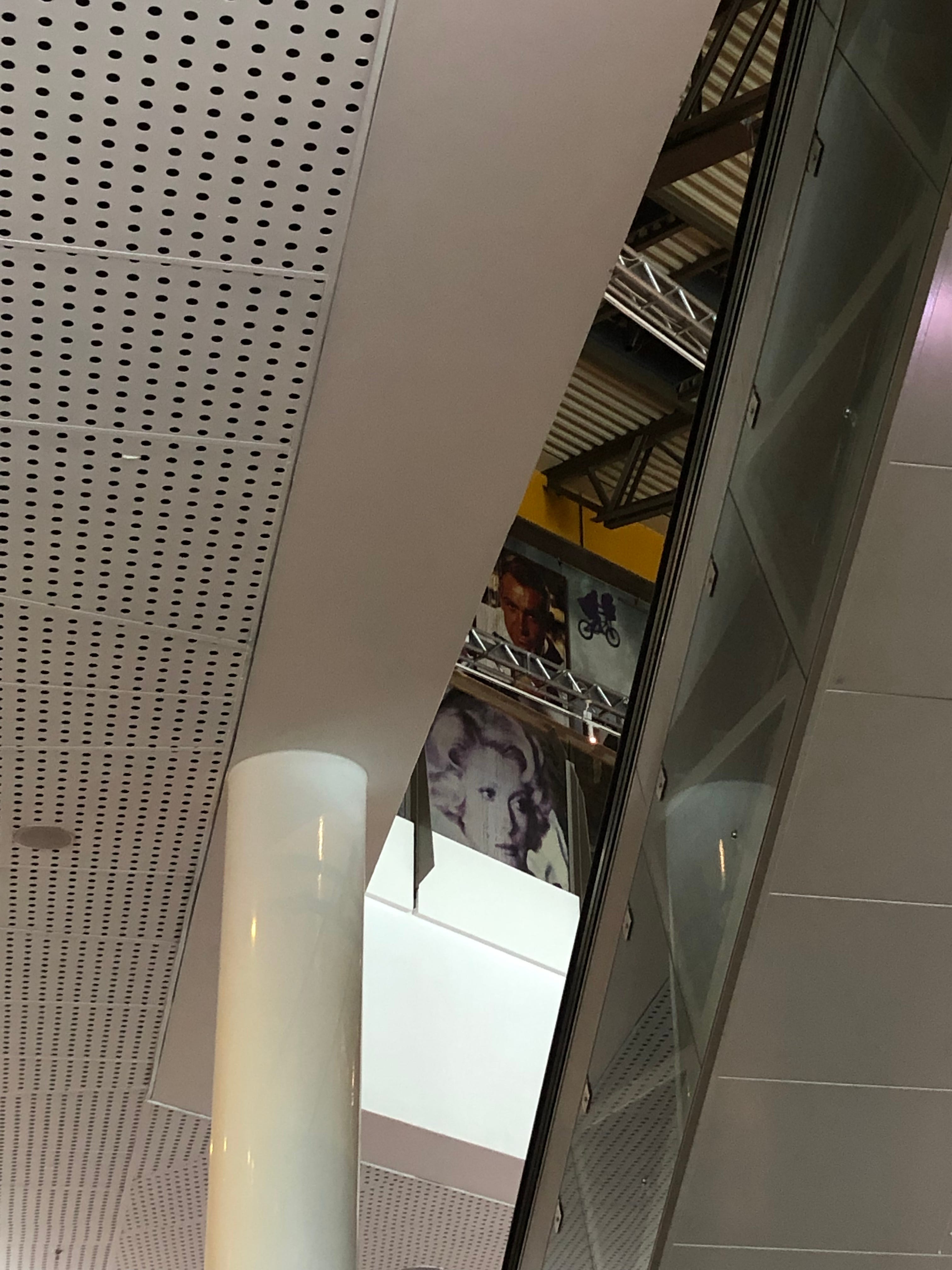
The sounds of screaming blend with the scraping of metal food-court chairs on hard floors, the perpetual toilet-flush sound of a fountain and the hum of escalators. The food court is called ‘Food District’, and hosts the world’s major cuisines: McDonald’s, China, pizza, Mexico and sushi.
The younger boy has refined (corrected) his rendition of Lou Reed:
He is on the sofa, watching an animated series about well-meaning South Korean trains (a spin-off from a series about well-meaning South Korean buses). His thighs are covered in red pen marks - a drawing that began on a sheet of paper went beyond its boundaries. He does everything with such enthusiasm that it can sometimes seem excessive. He is not shy. He shouts instead of talks, runs instead of walks, stands instead of sits, glugs instead of sips, screams instead of shouts, guffaws instead of titters. He maximises life in every dimension. His mother has just gone to work. His older brother has just gone to school. Soon the younger boy will go to kindergarten. Then it will be time to ignore the tiredness of having been up for hours, clean up the crime scene of breakfast, coordinate a wide range of laundry, conduct a telephone interview with a representative of the Swedish unemployment agency, tidy up the hundreds of toys distributed across the living room, travel to the studio, travel to the English artist and designer’s studio, attempt to stretch a piece of painted denim so it can be hung like a normal painting, drink more and more coffee, more and more Coke Zero, maybe even Pepsi Max, consider making a long trip to LIDL to buy a can of sugar-free Freeway, scribble with a soft pencil, read a single page of a book, fall asleep for a moment, run out of time, cycle desperately fast back to the kindergarten, run around, be polite to everyone (children, parents, staff), imagine then produce some kind of meal, take one or more children to football training, negotiate the bedtimes of other people, clear up enough toys to make space for a yoga mat, watch an old Adam Curtis film, remember an email, reply, see that’s it’s too late, then go to bed.